The full review
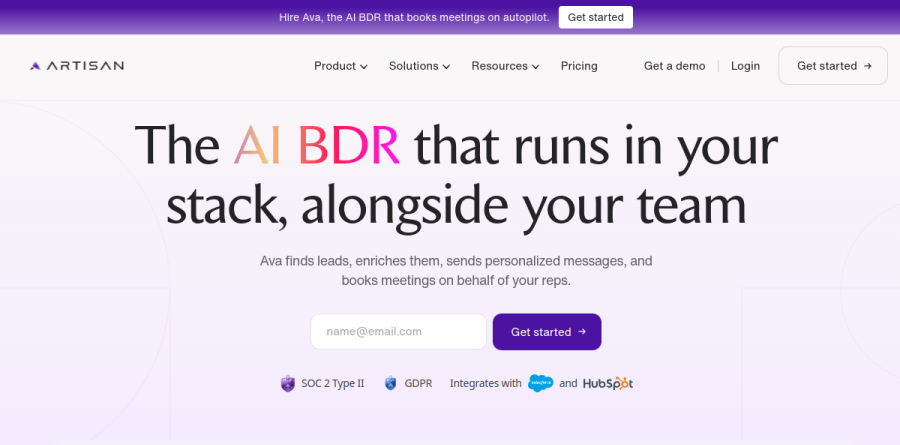
What is Artisan?
Artisan is an outbound sales platform built around Ava, which the vendor positions as an AI BDR that runs inside your existing stack alongside human reps. Rather than assembling a contact database, a sequencer, a deliverability tool and a scheduler separately, Artisan folds prospecting, enrichment, message writing, reply handling and meeting booking into a single agent.
The homepage frames the job plainly: Ava finds leads, enriches them, sends personalized messages and books meetings on behalf of reps. Navigation splits into Product, Solutions, Resources and Pricing, and the whole site is organized around that one agent rather than around a toolbox of disconnected modules.
How Ava runs a campaign end to end
Artisan describes the motion in three phases on its AI sales agent page. Ava first assembles ICP-matched leads and enriches them with signals such as hiring and funding activity. It then writes and sends individualized sequences across email and social, testing subject lines and delivery timing. Finally it reads replies, handles objections and books qualified meetings onto a calendar.
Autonomy is adjustable rather than binary, which matters for teams nervous about letting software speak for the brand. Artisan exposes approval requirements for outreach, tone and length restrictions, reply sensitivity thresholds, per-campaign budget caps, channel selection, lead routing rules and an instant pause, so a manager can loosen the leash gradually.
Lead data and buying signals

You are not expected to bring your own list. The Artisan B2B leads module draws on what the vendor reports as 250M+ verified contacts across 200+ countries, carrying job titles, emails and tech stack detail. A separate Local data module covers a reported 200M+ local businesses with verified emails and phone numbers, Google reviews and Instagram posts.
Above the database sits Signals, the layer deciding when to reach out rather than who. Artisan lists website visitor de-anonymization, funding tracking, hiring and growth activity, social monitoring and topic intent through a Bombora integration. Records sync automatically with Salesforce and HubSpot, with Ava syncing activity, respecting CRM owners and updating stages, and the lead pages also name Bombora, Google Maps and Instagram as data sources.
Deliverability and continuous optimization

Volume outbound dies on deliverability, and Artisan treats it as infrastructure rather than an afterthought. The AI outreach page lists domain warm-up, infrastructure rotation, send throttling, bounce monitoring, complaint tracking and inbox placement optimization as platform responsibilities, not chores for whoever drew the short straw.
Optimization runs continuously. Artisan argues that conventional A/B testing compares two variables at a time, while Ava evaluates many at once across subject lines, openers, personas, value props, CTAs, send times and channel mix, promoting winners automatically. Phone still belongs to people: the built-in power dialer queues calls for reps to make.
Campaign types and plan tiers
Cold outbound is the headline motion, but Artisan ships campaign types that matter more once a team has history. CRM campaigns work existing records, Cross-sell and upsell targets expansion inside accounts you already own, and Book meetings on autopilot handles the scheduling chase.
Three named tiers scope the platform by monthly lead volume: Team, Scale and Enterprise. Team already includes every campaign type, autonomous replies and meeting booking, the verified contact database, Salesforce and HubSpot sync, and CSM onboarding, with an AI dialer available per seat. Scale is flagged as most popular and adds a dedicated CSM, CRM setup and priority support. Enterprise layers on a forward-deployed strategist and advanced security controls with audit logs.
Who should choose Artisan
Artisan suits lean revenue teams with a sharply defined ICP and a real volume problem: startups and SMBs needing BDR-scale output without hiring three reps, and mid-market teams that would rather consolidate data, sending and CRM sync under one contract. Agencies and local-services sellers get unusual mileage from the Local data module.
It is a weaker fit for teams that want transparent self-serve pricing and a card-swipe start, because every tier is quoted through sales rather than published. Founder-led motions selling into a short list of named accounts, where each touch is bespoke, will find little for automation to compound.
Strengths
- Genuinely end-to-end automation: Ava sources leads, ghostwrites personalized sequences, handles objections, and books meetings without human input
- Bundled 250M+ verified B2B contact database across 200+ countries, enriched from 22+ sources with intent signals (funding rounds, hiring), replacing a separate data subscription
- Polished UI and fast onboarding, with CSM support on every tier and real-time Salesforce/HubSpot sync
- Autonomous A/B testing of subject lines, send times, and CTAs that improves with every send
Watch out for
- Zero pricing transparency: every tier requires a sales call, and 12-month annual contracts (est. $24,000+/year entry) are the norm
- Polarized outcomes: roughly 13% one-star G2 reviews, including a team reporting zero replies from 1,400 emails sent
- AI-generated copy quality is inconsistent; unsupervised sends have reportedly damaged email domain reputation and triggered LinkedIn spam flags
- Limited visibility and control over which leads Ava selects, and per-lead credit consumption (~20 credits/prospect) can burn through volume fast
Key features
| Feature | What it does |
|---|
| Ava AI SDR agent | Autonomous BDR that finds leads, writes outreach, handles replies and objections, and books qualified meetings directly to rep calendars, with customizable human-escalation rules. |
| 250M+ B2B contact database | Verified contacts across 200+ countries, searchable or importable from CRM, prioritized by intent signals like funding rounds and leadership hires. |
| AI personalization engine | Ghostwrites hyper-personalized sequences using 22+ data enrichment sources; every email is unique, with autonomous testing of subject lines, structure, and tone. |
| Multi-channel outreach | Email and social sequences on autopilot with queued call steps via an AI dialer add-on (priced per seat); choose active channels per campaign. |
| Autonomous reply handling | Ava reads every reply, answers questions, manages objections, qualifies interest, and books meetings; escalates to humans on rules you define. |
| CRM and stack integrations | Real-time two-way sync with Salesforce and HubSpot, plus Google Calendar, ZoomInfo, and BigQuery — no migration required. |
How Artisan compares
| Alternative | How it differs |
|---|
| 11x.ai | Closest head-to-head rival; AI SDR 'Alice' with similar quote-based enterprise pricing and autonomous outbound positioning. |
| Apollo.io | Self-serve data + engagement platform from $49/user/mo; far cheaper and more transparent, but you run campaigns yourself rather than delegating to an agent. |
| AiSDR | Lower-cost AI SDR alternative with published pricing (roughly $750-900/mo entry), better suited to smaller teams testing autonomous outbound. |
Frequently asked questions
How much does Artisan cost?
Artisan does not publish prices. All three tiers — Team (~2,500 leads/month), Scale (~6,000), and Enterprise — are quote-based with annual contracts. Third-party 2026 estimates put entry pricing near $2,000/month, scaling to $5,000+/month at higher volumes, roughly $24,000-$57,000+ per year. Pricing is driven mainly by how many leads Ava contacts each month.
What is Ava, Artisan's AI SDR?
Ava is an autonomous AI business development rep. She sources prospects from Artisan's 250M+ verified B2B contact database spanning 200+ countries, enriches them with 22+ data sources and intent signals, ghostwrites personalized email sequences, handles replies and objections, and books meetings on your calendar. Artisan claims teams generate pipeline at one-fifth the cost of a human BDR.
Artisan vs Apollo: which should I choose?
They solve different problems. Apollo is self-serve sales engagement plus data from $49/user/month — you write and run campaigns yourself. Artisan is a done-for-you AI agent estimated at $2,000+/month that executes outbound autonomously. Pick Apollo for budget and control; pick Artisan to replace SDR labor if you can absorb a $24,000+ annual contract.
Does Artisan have a free trial?
No. The official pricing page lists no free trial as of July 2026 — every tier requires a sales call and a scoped quote. Some earlier reviews mention a trial with $300 in free credits, but that offer no longer appears on artisan.co. Expect a demo, a custom proposal, and typically a 12-month commitment.
Is Artisan AI worth the money?
Results are polarized: Artisan holds roughly 3.9/5 on G2, with about 72% five-star but 13% one-star reviews. Wins include 5x prospecting capacity and doubled open rates; failures include zero replies from 1,400 emails. It pays off for teams with a clear ICP, real volume needs, and ops oversight — not as a hands-off magic button.
Artisan ratings on other platforms
Independent user ratings from third-party review sites, linked here for transparency.
These are not our editorial score, are captured on the date shown, and may have changed since.