The full review
What is PolyAI?
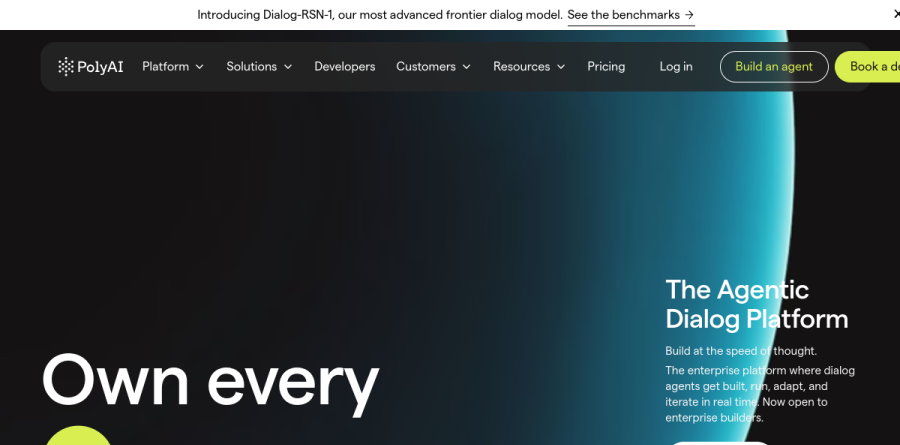
The product is enterprise voice AI: agents that answer inbound customer calls and hold a real conversation instead of pushing people through a touch-tone menu. PolyAI positions this as the Agentic Dialog Platform, and the homepage is blunt about the distinction it draws — a full-stack dialog agent built for enterprise customer engagement, not a chatbot with voice bolted on.
In practice a PolyAI agent picks up the phone, verifies the caller, and resolves the request end to end: ID checks, payments, appointment bookings, order questions. It hands off to a human only when the issue genuinely needs one. The technology page frames the goal as resolve rather than route, and one build can span voice, chat and multiple languages.
Two ways to build inside Agent Studio

PolyAI offers two entry points into Agent Studio, its central enterprise-ready platform for building dialog agents. PolyAI Agent Builder lets a non-technical operations lead describe a use case in plain language and get a working agent quickly; the vendor states you can sign up, describe your use case in plain language, and have an enterprise-ready voice agent built in under 10 minutes. Developers get the Agent Development Kit, a CLI tool and Python package that supports a GitHub workflow for building agents locally, with public ADK docs.
That split matters. Contact centre teams rarely want an engineering ticket just to reword a refund prompt, and engineers rarely want a black box. Agent Studio gives both groups one surface for building, testing, iterating and deploying.
The models behind the voice
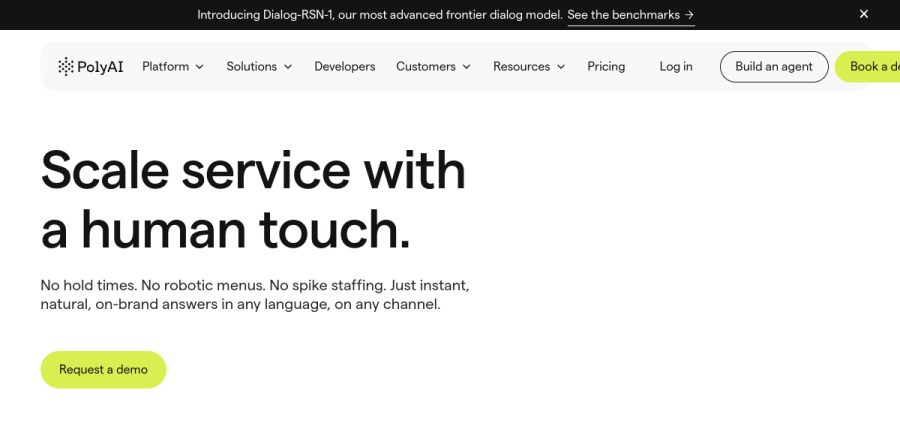
PolyAI runs its own stack rather than reselling a generic model, and the technology page names each layer. Raven is the proprietary LLM, which the vendor reports is trained on more than a billion real enterprise conversations and tuned for sub-second answers and adherence to business rules. Owl is the purpose-built ASR, described as cutting through static, strong accents and background noise while absorbing caller interruptions without losing the thread. For output, PolyAI blends human recordings with neural synthesis so the agent breathes like a person instead of reciting set phrases. The company has also announced Dialog-RSN-1, billed as its most advanced frontier dialog model.
Turning calls into operational insight
Beyond call handling, the PolyAI Supervisor Suite converts conversation data into something operations teams can act on. The vendor cites metrics including average handle time, call containment and FTE capacity provided, alongside dashboards you can customise for business-specific fields such as booking type, cancellation reasons and special requests. Analyst Agents add a generative layer so a supervisor can ask a plain-language question — the site offers the example of the most common calls about parcel-delivery problems over three months — and get an answer without waiting on a BI queue.
Governance, support and industry coverage
Every agent is governed by default, with SOC 2, HIPAA, GDPR and PCI DSS listed as standard plus full visibility into each agent decision. The pricing page details what ships with every deployment: a web ticket portal, a 24/7/365 emergency support line, a 99.9% uptime SLA on your phone lines, ongoing monitoring, and upgrades to new platform features. PolyAI also maintains dedicated pages for financial services, healthcare, hotels, insurance, restaurants, retail, telecom and utilities, and for use cases including authentication, billing and payments, call routing and order management.
Who should choose PolyAI
The platform suits enterprises where the phone line is a revenue channel rather than only a cost centre: hotels, restaurants, utilities, banks, insurers and healthcare providers carrying heavy inbound volume. It fits best when brand voice and compliance are non-negotiable, and when calls get messy — multilingual, noisy, or involving authentication and payment. Named customers on the site include PG&E, UniCredit, Fogo de Chao, Audibel, Quicken and Golden Nugget, which tells you the intended profile.
PolyAI is not ideal for small teams or early-stage products with modest call volume. There is no published rate card - the pricing page says ongoing use of the voice agent is priced on a per-minute basis, which includes proactive performance improvements, maintenance and 24/7 support - though the Agent Studio page offers a self-serve "Start building" link into studio.poly.ai alongside "Contact sales."
Strengths
- Best-in-class voice realism and natural turn-taking, built on its proprietary Raven model
- Strong call-containment rates reported in production (often cited 60%+)
- Fully managed delivery — PolyAI builds, tunes, and maintains the agent for you
- Enterprise compliance baked in: SOC 2, HIPAA, GDPR, PCI DSS, 99.9% SLA
Watch out for
- No public pricing and a six-figure entry point that excludes SMBs
- Per-minute billing plus separate telephony, integration, and compliance fees make total cost hard to predict
- Multi-week implementation and limited self-serve iteration — changes go through consulting cycles
- Managed-service model creates vendor dependency and less hands-on control
Key features
| Feature | What it does |
|---|
| Raven conversational model | Proprietary voice model trained on 1B+ enterprise conversations for natural, low-latency dialog. |
| Agent Studio & ADK | A no-code studio for business users plus an Agent Development Kit for developers to build and adapt agents. |
| Multilingual voice agents | Handles authentication, routing, billing, bookings, FAQs, and order management across many languages. |
| CCaaS & telephony integration | Connects to existing contact-center stacks and carriers over SIP with elastic call scaling. |
How PolyAI compares
| Alternative | How it differs |
|---|
| Synthflow | Self-serve voice AI with transparent, lower-cost plans — far more accessible to SMBs and mid-market. |
| Vapi | Developer-first voice AI platform with usage-based pricing and fast self-serve setup. |
| Cognigy | Enterprise conversational AI (voice + chat) that competes directly for large regulated deployments. |
Frequently asked questions
Does PolyAI publish its pricing?
No. PolyAI is quote-only with a single sales-led enterprise plan. Ongoing use is billed per minute of conversation, and third-party sources estimate annual commitments typically start around $150,000 — but PolyAI publishes no rate card.
Is there a free trial?
No free trial or free tier. Evaluation happens through a sales-led demo and a scoped pilot, which itself usually requires a low six-figure commitment.
PolyAI ratings on other platforms
Independent user ratings from third-party review sites, linked here for transparency.
These are not our editorial score, are captured on the date shown, and may have changed since.