The full review
What is Hume AI?
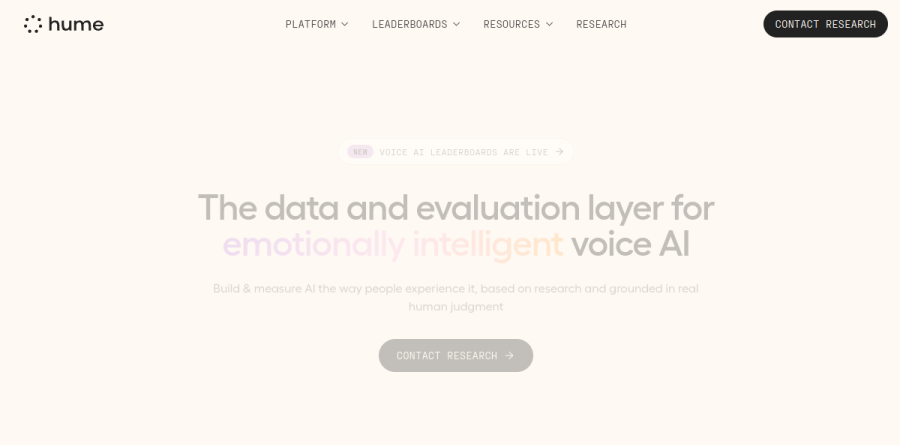
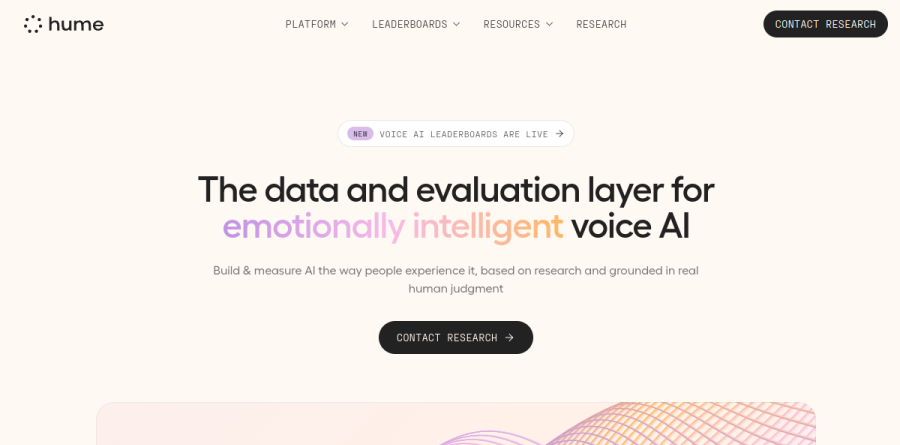
Hume AI builds voice models and measurement APIs for developers who care how speech lands on a listener. The current homepage frames the company as the data and evaluation layer for emotionally intelligent voice AI. Beneath that positioning sit the developer products: Octave for text to speech, EVI for real-time speech-to-speech, plus APIs for expression measurement and human feedback.
Hume documentation describes Octave as a text-to-speech system built on LLM intelligence, a speech-language model reading context rather than simply pronouncing characters. The system decides when a line should be whispered, shouted, or delivered calmly.
Octave 2 and voice design
Octave 2 is the preview release of Hume's text-to-speech model, live alongside EVI 4-mini and adding expanded language support and lower latency over Octave 1. Voice Design lets a developer describe a speaker in plain language, such as a patient counselor or a dramatic medieval knight, returning a matching voice. Teams needing a specific person can use voice cloning, which the vendor reports works from as little as 15 seconds of audio, or pull from the Voice Library of more than 100 presets.
For long-form work, the Continuations feature keeps emotional state consistent across a session, so a character arc moving from joy to despair does not reset between chunks of a podcast. Acting instructions are listed as coming soon in the Octave 2 preview, and Hume states that users retain ownership of generated audio.
Real-time conversation with EVI
EVI, the Empathic Voice Interface, is the Hume AI speech-to-speech API. Hume describes it as a real-time emotionally intelligent voice AI that measures the tune, rhythm, and timbre of speech, then answers through a speech-language model. That shows up in conversational mechanics: end-of-turn detection driven by the user's tone of voice, interruptibility that stops rapidly and resumes with the right context based on where it left off, and an empathic tone matched to the user's vibe.
Integration is developer-first. Official SDKs cover Next.js with a React client, TypeScript, and Python, while EVI configurations define system behavior and voice settings. An EVI Playground lets teams test a configuration before shipping code, supplemental LLM partners such as Anthropic, OpenAI, Google, and Fireworks can be slotted in, and EVI 4-mini adds multilingual support.
Kairos, expression measurement, and human feedback
The other half of Hume AI's current lineup is evaluation. The Kairos Platform auto-generates test scenarios, runs them as agent-to-agent or human-to-agent conversations, and surfaces what breaks before a voice agent meets real customers. The Expression Measurement API handles live measurement and offline analysis across what the vendor reports as 48 or more emotion categories.
The Human Feedback API routes output to real participants and returns scored results in hours rather than days. Hume also publishes leaderboards: a Real World VoiceEQ Bench covering speech recognition, understanding, text to speech, and speech-to-speech, plus an SLM Judge board ranking how closely language models agree with human raters.
How Hume AI plans scale with usage

Plan structure follows monthly usage allowances across seven tiers, from Free through Enterprise. Free exists for evaluation, Starter and Creator suit solo builders, and Pro, Scale, and Business step up monthly TTS character allowances, included EVI minutes, and concurrent connection limits, with team seats appearing only at Scale (3) and Business (5). Enterprise removes the caps.
Overages are metered, with extra characters priced per thousand for text to speech and a per-minute rate for EVI usage, and the unit rate improves on higher plans. Compliance tiers up too: Hume lists SOC 2 Type II, GDPR, and HIPAA alongside Slack support at the Enterprise level, while lower plans rely on Discord. Voice cloning is unlimited on every tier.
Who should choose Hume AI
Hume AI suits developers shipping products where delivery carries meaning: digital companions, coaching and interview tools, narration pipelines, and support agents that should hear frustration and adjust. A generative TTS engine, a speech-to-speech API, and a measurement stack sit under one account, and the evaluation products earn their place when you must prove an agent behaves well.
It is a poor fit for non-technical teams wanting a finished call-center or IVR product, since this is an API platform assuming engineering time. Skip it for batch narration where flat, inexpensive synthesis is the only requirement.
Strengths
- Best-in-class emotional prosody: reads vocal cues and adjusts tone, sounding far less flat than typical TTS bots
- Generous, no-trial free tier plus cheap entry paid plans make experimentation and prototyping easy
- Unified stack: Octave TTS, EVI 3/4 speech-to-speech, and Expression Measurement API from one vendor with unlimited voice cloning
- Transparent, published self-serve pricing with declining overage rates at higher tiers, undercutting rivals on volume
Watch out for
- It's an API/model layer, not a turnkey contact-center suite: no built-in call routing, dashboards, or CCaaS telephony
- Latency (~200-300ms) is competitive but trails ElevenLabs Flash for ultra-low-latency call handling
- No commercial license below the Creator ($14) tier, and free/Starter quotas exhaust within a couple of days of real use
- Language coverage (~11, expanding toward 20+) lags broader-language competitors
Key features
| Feature | What it does |
|---|
| Empathic Voice Interface (EVI 3/4) | Real-time speech-to-speech model that detects prosody and emotional cues and responds with matching tone and inflection. |
| Octave TTS | Context-aware text-to-speech engine with unlimited voice cloning and expressive, direction-following delivery across all tiers. |
| Expression Measurement API | Pay-as-you-go analysis of emotional expression in video, audio, and text (~$0.06-0.08/min audio-video, $0.00024/word). |
| Enterprise compliance | SOC 2, GDPR, and HIPAA options with dedicated support for regulated deployments on the Enterprise plan. |
How Hume AI compares
| Alternative | How it differs |
|---|
| ElevenLabs | Broader voice library and lower-latency Flash model; stronger turnkey Conversational AI agent tooling. |
| Vapi | Purpose-built voice-agent orchestration platform with telephony, tools, and call routing Hume lacks. |
| Retell AI | Contact-center-focused voice agents with phone integration and call analytics out of the box. |
Frequently asked questions
Is there a free plan?
Yes. The free tier gives 10,000 TTS characters (~10 minutes) and 5 minutes of EVI usage per month with 1 concurrent connection, but it has no commercial license, so output cannot be used in monetized products.
Is Hume AI a full contact-center platform?
Not really. It provides the voice models and APIs (EVI speech-to-speech, Octave TTS, Expression Measurement), but you build the agent, telephony, and routing around it or use a partner platform. Full CCaaS features come only via custom Enterprise engagements.
Hume AI ratings on other platforms
Independent user ratings from third-party review sites, linked here for transparency.
These are not our editorial score, are captured on the date shown, and may have changed since.