The full review
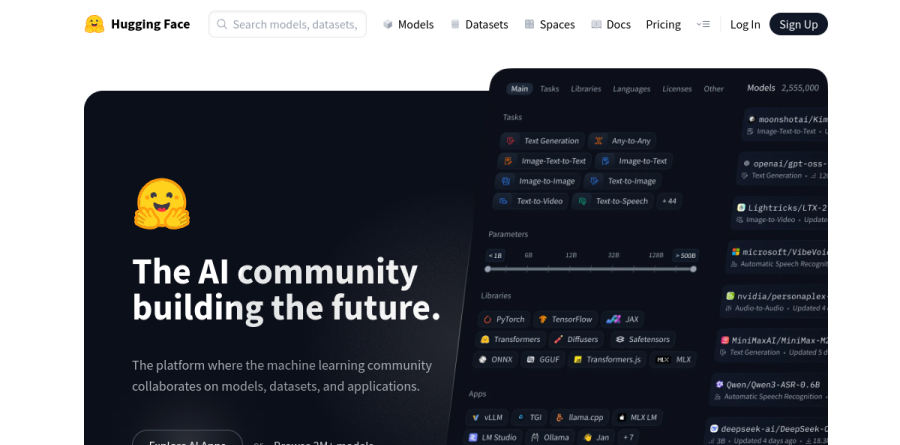
What is Hugging Face?
Hugging Face is the open hosting layer for machine learning. The vendor calls it the platform where the machine learning community collaborates on models, datasets and applications. Three git-backed repository types sit at its core, Models, Datasets and Spaces, joined by the APIs and rented compute needed to run whatever you find.
Scale is the whole argument. Hugging Face reports more than two million models, over 500,000 datasets and upwards of a million Spaces, with over 50,000 organizations on the platform. That breadth is what makes the Hub a practical first stop for teams evaluating open models rather than committing to a single closed API.
Inside the Hub
Every artifact on the Hub is a git repository, so the workflow feels familiar to anyone who has used GitHub. The same git tooling the Hub uses for model and dataset repositories works on Spaces too, and Hugging Face lists a Dataset Viewer among plan features, extending it to private datasets on PRO and Team. Spaces turn a repo into a live demo, with Gradio, Docker and static HTML as SDK options, and each new commit rebuilds and restarts the app automatically. Hugging Face documents three visibility levels for Spaces, public, protected and private, where protected keeps source code hidden while the running app stays reachable through its embed URL or a custom domain.
Inference Providers as a single API layer
Inference Providers gives developers access to hundreds of machine learning models running on partner infrastructure through a single, consistent API. A single Hugging Face token routes requests across partner networks including Groq, Cerebras, Together, Replicate, fal, Fireworks, Novita, Baseten and Scaleway, covering chat completion, vision-language models, feature extraction, text-to-image, text-to-video and speech-to-text. The router exposes an OpenAI-compatible endpoint, so migrating existing code is often a base URL swap. Provider selection policies are genuinely useful, since appending fastest, cheapest or preferred to a model id tells the router how to choose, with automatic failover when a provider is flagged unavailable. The vendor states it applies no extra markup on provider rates.
Renting accelerators without an infrastructure team
For workloads needing dedicated capacity, Inference Endpoints deploy a model onto managed hardware billed by the hour, spanning Intel Sapphire Rapids CPU instances up through Nvidia T4, H100 and B200 accelerators. Spaces hardware works the same way for demos and internal tools, with a menu running from CPU Basic through T4, L4, L40S, A10G and A100 configurations. ZeroGPU is the interesting middle ground, offering dynamically allocated Nvidia RTX Pro 6000 Blackwell capacity at no cost, with larger quotas on paid plans. Small teams get accelerator access without procurement, and the Inference Playground lets you compare model responses before committing.
Team and Enterprise governance
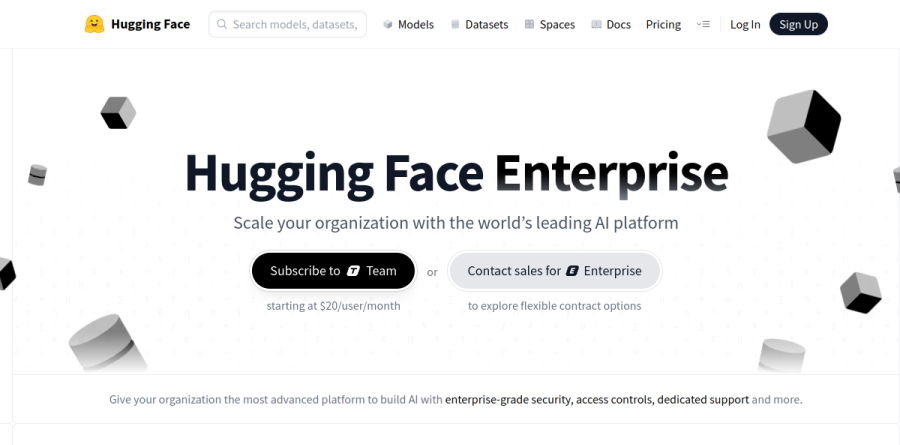
Organizations get the governance layer you would expect from a platform holding proprietary weights. The Team plan adds Single Sign-On through SAML and OIDC, Audit Logs, Resource Groups for granular per-repository access, Storage Regions for data location control, Token Management and Repository Analytics. Enterprise layers on SCIM user provisioning, network security, managed billing and priority support. Hugging Face states it is SOC 2 Type II certified and GDPR compliant. Private storage scales with seats, and Inference Providers usage can be billed to the organization rather than to individual member accounts.
Who should choose Hugging Face
Hugging Face is close to mandatory for ML engineers, applied researchers and product teams building on open models, since the combination of catalog breadth, git-native versioning and pay-as-you-go inference has no real equivalent elsewhere. It suits startups wanting GPU access without a cloud contract, and enterprises needing SOC 2 attestation and SSO around private model repositories. It is a poor fit for non-technical teams who simply want a ready-made chat assistant, because the platform assumes comfort with Python, access tokens and model cards. Note also that Gradio and Docker Spaces require a paid plan to create, PRO for personal accounts and Team or Enterprise for organizations, though static Spaces remain free for everyone and free personal accounts in good standing can still host up to two Gradio Spaces on ZeroGPU.
Strengths
- Massive free tier — the entire model/dataset Hub and open-source libraries cost nothing
- Transparent, published per-hour compute pricing billed by the minute with scale-to-zero
- Pro is only $9/mo, one of the cheapest paid AI-platform seats on the market
- Multi-cloud Inference Endpoints (AWS, GCP, Azure) with no vendor lock-in
Watch out for
- Real bills come from GPU-hours and storage, not the seat price — costs can surprise
- An always-on T4 endpoint runs ~$365/yr even before serving a single request
- Enterprise at $50/user/mo is pricier per seat than many DevOps tools
- Free Inference Providers credits are limited; heavy inference forces paid endpoints fast
Key features
| Feature | What it does |
|---|
| Model & Dataset Hub | 1M+ open-source models and datasets with Git-based versioning, free to host and download |
| Inference Endpoints | Managed autoscaling deployment on dedicated CPU/GPU/accelerator hardware, per-minute billing |
| Spaces | Host ML demo apps (Gradio/Streamlit/Docker) on free CPU or paid GPU hardware from $0.40/hr |
| ZeroGPU | Shared on-demand GPU pool for Spaces; free quota, 8x expanded on Pro |
| Enterprise Hub | Private org with SSO/SAML, SCIM provisioning, audit logs, resource groups and analytics |
| Inference Providers | Unified API routing to serverless third-party providers with included monthly credits |
How Hugging Face compares
| Alternative | How it differs |
|---|
| Replicate | Also per-second GPU pricing for running/deploying models, but no comparable open model+dataset hub |
| AWS SageMaker | Deeper MLOps pipeline and training tooling, but steeper learning curve and AWS lock-in |
| Together AI | Serverless inference for open models with per-token pricing; narrower than HF's full platform |
Frequently asked questions
How much does Hugging Face cost?
The core Hub is free. Paid seats are Pro at $9/month per user, Team at $20/month per user, and Enterprise at $50/month per user (a negotiated floor). Compute is separate and usage-based: Inference Endpoints run $0.033–$80/hour and Spaces GPUs $0.40–$23.50/hour, all billed by the minute.
Is Hugging Face free?
Yes, largely. Hosting and downloading public models, datasets and Spaces is 100% free, along with the open-source Transformers libraries and a free ZeroGPU quota. You only pay when you want Pro features ($9/mo), private storage above quota, or dedicated GPU compute for Inference Endpoints and Spaces.
How much are Hugging Face Inference Endpoints per hour?
Pricing is pay-as-you-go by the minute. CPU instances start at $0.033/hour. GPUs range from $0.50/hour for an Nvidia T4 to $2.50 (A100 80GB) and $10/hour for an H100, scaling to $80/hour for 8x H100. AWS Inferentia and GCP TPU accelerators are also available.
What is the difference between Hugging Face Team and Enterprise?
Both are per-seat org plans. Team ($20/user/month) adds SSO, audit logs, resource groups, and PRO inference perks for all members. Enterprise ($50/user/month) layers on SCIM provisioning, the highest rate limits, dedicated support, and custom SLAs, and is negotiated annually with sales for larger deployments.
Hugging Face vs Replicate — which is cheaper?
Both bill GPU compute by usage, so rates are comparable. Hugging Face wins on breadth: a free model/dataset hub, cheap $9 Pro seat, and multi-cloud endpoints. Replicate is simpler for one-off model runs with per-second billing but lacks HF's hub, datasets, and enterprise governance features.
Hugging Face ratings on other platforms
Independent user ratings from third-party review sites, linked here for transparency.
These are not our editorial score, are captured on the date shown, and may have changed since.