The full review
What is Vertex AI?
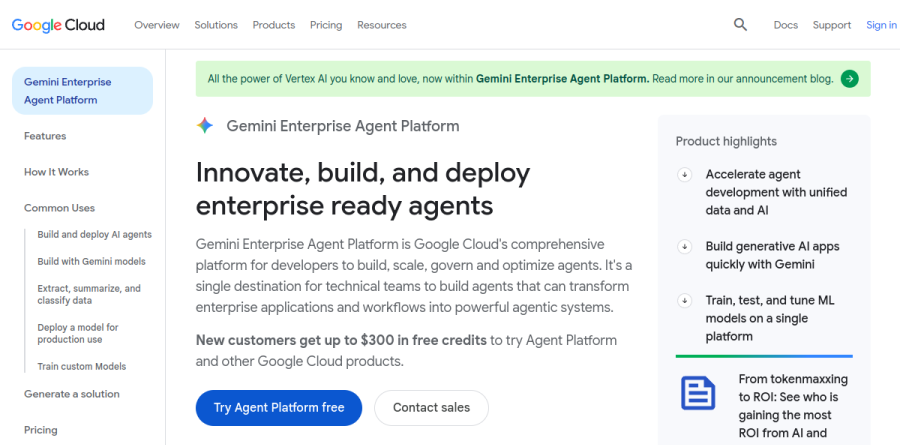
Vertex AI is Google Cloud's managed platform for building, training, deploying, and governing machine learning models and AI agents. Visitors should know it now carries a new name: Google Cloud presents the product as Gemini Enterprise Agent Platform, formerly Vertex AI, and while the product URLs and the Vertex AI SDK still carry the old name, the pricing page has renamed the services themselves to Agent Platform Pipelines, Agent Platform Feature Store, and Agent Platform Workbench.
It bundles two stacks most companies would otherwise buy separately. One is generative: Gemini model access, prompt tooling, agent runtimes, and grounding. The other is conventional MLOps: custom training, AutoML, pipelines, a model registry, and feature management. Both meter by consumption rather than seats.
Inside Model Garden

Model Garden is the catalog at the center of Vertex AI and its clearest selling point. The vendor reports more than 200 curated models across three groups: Google first-party releases including Gemini, Imagen and Gemini 3 Pro Image for text-to-image, Veo for video, and Chirp for speech-to-text; open models such as Gemma, CodeGemma, PaliGemma, Meta's Llama, Mistral AI, and TII's Falcon; and third-party options, currently Anthropic's Claude Model Family. The vendor's pitch is that you can customize these models with your own data, deploy them to applications with just one click, and scale with end-to-end MLOps built in.
Agent Studio is where prompts get designed, tested, and managed using natural language, code, images, or video. Code-first teams get the Agent Development Kit for building agents directly. Google Antigravity, offered as a desktop application and an Antigravity CLI, orchestrates several agents through a multi-step workflow at once. Finished agents register into the Gemini Enterprise app for governance, and their runtime meters on Agent Compute, Agent Memory, and Agent Storage, each carrying a free monthly allowance.
MLOps for predictive machine learning
Vertex AI has not abandoned classical machine learning. Custom training accepts your own framework, code, and hyperparameter tuning, running on CPU, multi-GPU, or TPU configurations. AutoML covers image classification, object detection, tabular regression, and forecasting for teams without a research bench. Around those sit Pipelines for orchestration, Model Registry for versioning, Feature Store for reuse, and monitoring for input skew and drift. Notebooks arrive as Colab Enterprise or Workbench, natively integrated with BigQuery.
Grounding and evaluation controls
Two capabilities separate Vertex AI from a bare model endpoint. Grounding ties responses to real sources through Grounding with Google Search, Web Grounding for Enterprise, Grounding with Google Maps, and Grounding with your data. Evaluation runs through the Model Evaluation service and Gen AI Evals, supporting pointwise and pairwise judging by an autorater model alongside computation-based metrics such as Exact Match, Bleu, Rouge, and tool-call checks including Tool Call Valid and Tool Name Match.
How consumption billing behaves
Everything meters, so cost planning becomes real work. Requests failing with 4xx or 5xx codes are not billed, batch mode and cached input cost less than standard calls, and training bills in thirty-second increments with no minimum duration. Discount levers include Spot VMs, Compute Engine reservations with committed use discounts, and Flexible Savings Plans. The common trap is a deployed endpoint, which accrues charges even when no prediction is made until you undeploy it.
Who should choose Vertex AI
Vertex AI fits organizations already committed to Google Cloud, especially data teams whose warehouse is BigQuery, and enterprises needing model choice alongside governance. It suits groups running predictive ML and generative work together, since Google Cloud markets purpose-built MLOps tools for predictive and generative AI on one platform, with Colab Enterprise or Workbench notebooks providing a single surface across all data and AI workloads. It is aimed at businesses rather than solo builders, since Google Cloud pitches Agent Platform as the way for enterprises to rapidly build, scale, govern and optimize enterprise-grade agents, though the product page notes you can also start testing Gemini on it with an API key. Anyone needing a predictable flat monthly invoice will find consumption billing uncomfortable.
Strengths
- Native, first-party access to the full Gemini lineup (2.5 and 3.x) with batch (50% off) and context-caching (up to 90% off) discounts.
- True pay-as-you-go with no license or seat fees, plus a $300 credit valid 90 days to start.
- End-to-end coverage: AutoML, custom training, pipelines, feature store, vector search, and Agent Engine in one console.
- Model Garden also hosts third-party models (Claude, Llama) for vendor flexibility.
Watch out for
- Always-on endpoints, notebooks, and vector-search nodes bill per node-hour even when idle, causing surprise bills.
- GPU/TPU compute carries a Vertex management fee (~$0.44/hr on an A100) on top of raw Compute Engine rates.
- Pricing is fragmented across 16+ services and varies by region, making cost forecasting hard.
- The 2026 rebrand to Gemini Enterprise Agent Platform adds naming and new billing lines (e.g., Sessions/Memory Bank charges).
Key features
| Feature | What it does |
|---|
| Model Garden | Deploy Gemini plus third-party models like Claude and Llama from one catalog. |
| AutoML | No-code training for image, tabular, and text models; image from $3.47/node-hr, tabular ~$21.25/node-hr. |
| Custom Training | Bring your own code on CPU/GPU/TPU billed per hour; A100 ~$3.37/hr including the management fee. |
| Online & Batch Prediction | Managed endpoints billed per node-hour; batch prediction runs about 50% cheaper. |
| Vertex AI Search | Grounded RAG search at $4 per 1,000 standard and $6 per 1,000 advanced queries. |
| Agent Engine | Managed agent runtime at $0.0864/vCPU-hr plus $0.0090/GB-hr memory. |
How Vertex AI compares
| Alternative | How it differs |
|---|
| AWS SageMaker | Closest rival; deeper infrastructure control and larger instance catalog, but weaker native foundation-model story. |
| Azure AI Foundry / ML | Microsoft's equivalent; strong OpenAI model access and enterprise integration. |
| Databricks Mosaic AI | Lakehouse-native MLOps; best for teams centered on Spark and data engineering. |
Frequently asked questions
How much does Vertex AI cost?
Vertex AI is usage-based with no base fee. Gemini 2.5 Flash-Lite runs $0.10 input and $0.40 output per 1M tokens; Gemini 2.5 Pro is $1.25/$10 per 1M. Custom training on an A100 GPU is roughly $3.37/hour, and AutoML image training is $3.47 per node-hour. Real bills range from under $100 for prototyping to $100,000+ at enterprise scale.
Is Vertex AI free?
There is no free plan, but new Google Cloud accounts get a $300 credit valid for 90 days. A few services add small monthly free tiers, such as 5,000 grounding-with-Search queries per month. Everything else is pay-as-you-go, and deployed prediction endpoints keep billing per node-hour even while idle until you undeploy them.
Vertex AI vs SageMaker: which is cheaper?
Both are usage-billed, end-to-end ML platforms. Vertex AI leads on native Gemini access, AutoML, and a unified console; AWS SageMaker offers deeper infrastructure control and more instance types. Vertex adds a management fee on GPUs (about $0.44/hr on an A100), while SageMaker layers a similar ~40% markup over raw EC2. Pick by your existing cloud.
Why is my Vertex AI bill so high?
The usual culprit is always-on infrastructure. Online prediction endpoints, vector-search nodes, Workbench notebooks, and feature stores bill per node-hour whether or not you send requests. One idle image-classification endpoint at $1.375/node-hour is roughly $1,000/month. Gemini 3.x reasoning tokens also bill as output, inflating token costs 5-10x. Undeploy idle endpoints.
Does Vertex AI charge per token?
Yes, for generative AI. Gemini models bill per 1M tokens split into input and output, e.g. Gemini 2.5 Pro at $1.25 input and $10 output (up to 200K context). Batch mode cuts that 50% and context caching up to 90%. Traditional ML (training, prediction, AutoML) instead bills per node-hour or GPU-hour, not per token.
Vertex AI ratings on other platforms
Independent user ratings from third-party review sites, linked here for transparency.
These are not our editorial score, are captured on the date shown, and may have changed since.
