The full review
What is Amazon SageMaker?
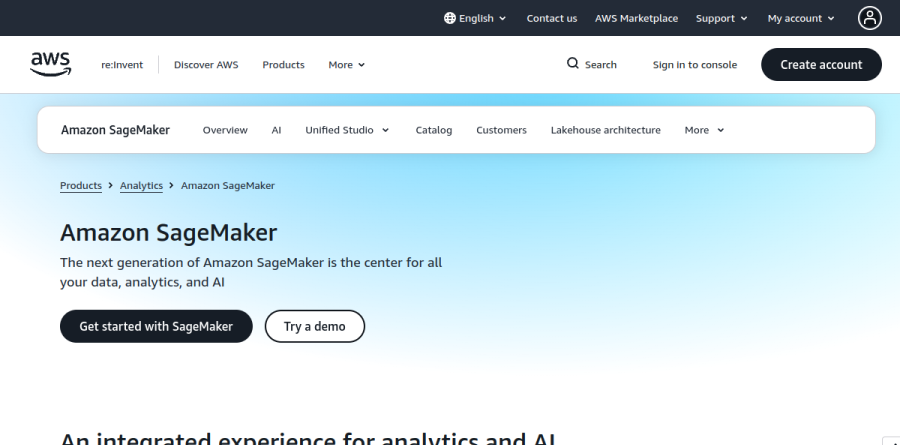
Amazon SageMaker is the managed machine learning and AI platform from Amazon Web Services, and it has grown well past its original identity as a place to train models. AWS now presents SageMaker as the center of gravity for data, analytics, and AI work on the cloud, organized into four named pillars: SageMaker AI for model development, SageMaker Unified Studio as the integrated workbench, SageMaker Lakehouse for unified data access, and SageMaker Catalog for governance, which AWS notes is built on Amazon DataZone.
In practice a team can query a warehouse, prepare a dataset, fine-tune a foundation model, and push an endpoint into production without leaving one environment. The model-building service itself lives on as SageMaker AI, which AWS presents as the pillar for building, training, and deploying ML models, including foundation models, with fully managed infrastructure, tools, and workflows.
Inside SageMaker Unified Studio
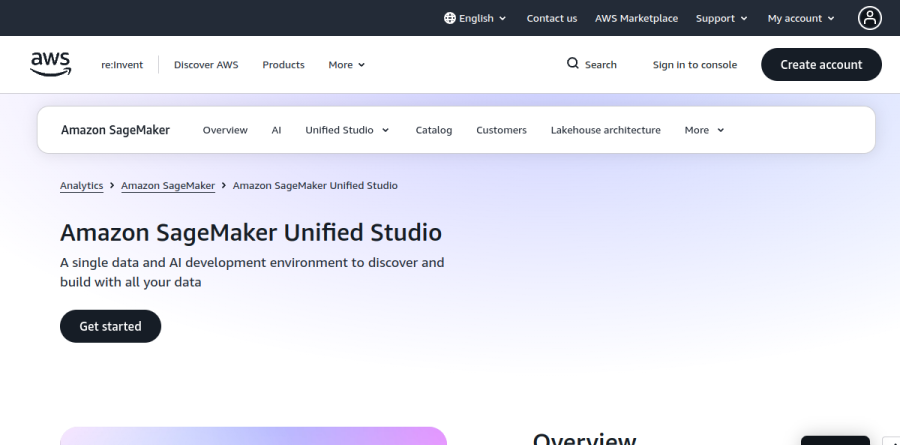
Unified Studio is where the consolidation becomes visible. AWS describes an immersive notebook experience where SQL queries and Python run side by side against large datasets, alongside a built-in SQL editor and visual ETL job builders for pipeline work. Projects are the organizing unit, so a data engineer, an analyst, and an ML engineer share artifacts inside a governed boundary instead of passing files around. Two assistants sit in the workflow: the SageMaker Data Agent, which the vendor says turns natural language prompts into code and step-by-step plans, and Amazon Q Developer for project onboarding and model building.
Model development with SageMaker AI

SageMaker AI keeps Studio as a single web-based interface for end-to-end model development. JumpStart is the on-ramp for teams that would rather not start from scratch — AWS says it provides access to hundreds of publicly available foundation models, with customization paths for widely used families including Amazon Nova, Llama, Qwen, DeepSeek, and GPT-OSS. Managed MLflow handles the unglamorous but decisive part, tracking and comparing iterative experiments so a fine-tuning run from three weeks ago can still be reproduced and defended in a review.
Training and inference at scale
HyperPod is the SageMaker answer for large training jobs, pairing automated cluster management, which the vendor reports can reduce training time by up to 40 percent, with checkpointless training and elastic training for resilience when nodes drop mid-run. On the serving side, SageMaker AI covers real-time, serverless, asynchronous, and batch inference across more than 70 instance types. That range matters, because an overnight batch scoring job and a latency-sensitive production API have almost nothing in common operationally, and each workload can be matched to a serving mode rather than forced into one pattern.
Data foundation and governance
SageMaker Lakehouse targets data silos with a single access layer over Amazon S3 data lakes, Amazon Redshift warehouses, and federated sources, with zero-ETL integrations cutting the copy-and-sync work that usually precedes model training. SageMaker Catalog applies governance on top — metadata, discovery, and access policy — so security review becomes part of the platform rather than a separate project run alongside it. The main SageMaker page pairs this governance layer with fine-grained access controls, data classification and toxicity detection, sensitive data detection, and data and ML lineage tracking.
How SageMaker billing is structured
Four models are worth understanding before committing. The Free Tier covers a defined allowance of Studio notebook, training, and real-time inference hours during an initial two-month window. On-Demand bills per instance-hour with no commitment. SageMaker Savings Plans trade a usage commitment for a substantial discount on sustained compute. Serverless Inference bills by inference duration and data processed, while SageMaker Catalog charges per request and per gigabyte of metadata stored. One planning caveat from the site itself: several legacy features, among them Ground Truth, Model Monitor, Clarify, Debugger, and Studio Lab, are listed as no longer available to new customers.
Who should choose Amazon SageMaker
SageMaker fits organizations already invested in AWS that need machine learning and generative AI work governed by the same identity, networking, and audit controls as everything else they run. It rewards teams with genuine scale — recurring training jobs, several models in production, data spread across S3 and Redshift — and teams whose sustained GPU spend justifies a Savings Plan. It is not ideal for a solo developer or an early-stage team that simply wants one model shipped this week, since the surface area, the IAM setup, and the instance-level cost decisions demand attention a lighter managed inference API would never ask for.
Strengths
- Pay only for what you use with per-second billing and no upfront commitment
- Deep AWS integration (S3, IAM, EMR, Redshift) plus Savings Plans up to 64% off
- Full ML lifecycle in one platform: notebooks, training, tuning, deployment, monitoring
- 2-month free tier covers notebooks, training, and inference for evaluation
Watch out for
- Costs are hard to predict; idle notebooks and endpoints run up bills fast
- Steep learning curve and heavy AWS-specific tooling
- Free tier is only 2 months, far shorter than AWS's usual 12-month tier
- Unified Studio bills underlying EMR, Redshift, and storage separately, complicating budgeting
Key features
| Feature | What it does |
|---|
| Managed notebooks & Studio | JupyterLab/Studio IDEs on managed instances (e.g. ml.t3.medium, ml.m5.large) billed per second of use. |
| Training & tuning | Distributed training and automatic hyperparameter tuning; pay per instance-hour, e.g. ml.m4.4xlarge at $0.96/hr. |
| Real-time & serverless inference | Deploy endpoints billed per instance-hour, or serverless inference billed by compute duration and requests. |
| SageMaker Unified Studio | Single environment unifying data, analytics, and ML; underlying AWS services (EMR, Redshift, EFS) billed individually. |
| Savings Plans | Commit to 1 or 3 years for up to 64% off on-demand ML pricing across instance families and regions. |
| Feature Store & Data Wrangler | Managed feature storage and data prep; free tier includes 10M read/write units, 25GB storage, and 25 Data Wrangler hours. |
How Amazon SageMaker compares
| Alternative | How it differs |
|---|
| Google Vertex AI | GCP's managed ML platform; similar usage-based pricing, strong for teams on Google Cloud and Gemini models. |
| Azure Machine Learning | Microsoft's MLOps platform; pay-as-you-go compute, best fit for Azure and enterprise Microsoft shops. |
| Databricks | Lakehouse-based ML/AI platform; DBU-based pricing, strong for data engineering plus ML on any cloud. |
Frequently asked questions
How much does Amazon SageMaker cost?
SageMaker uses pay-as-you-go pricing billed per second with no upfront cost. You pay per instance-hour: an ml.m5.large Studio notebook runs about $0.115/hour, an ml.c5.xlarge about $0.204/hour, and ml.m4.4xlarge training about $0.96/hour. Storage and inference are billed separately, so total cost depends entirely on usage.
Is Amazon SageMaker free?
SageMaker AI offers a 2-month free tier starting when you create your first resource. It includes 250 hours of ml.t3.medium notebooks, 50 hours of training, 125 hours of real-time inference, and 150,000 seconds of serverless inference. After two months, or beyond those limits, standard pay-as-you-go rates apply. There is no permanent free plan.
Does Amazon SageMaker have a free trial?
Yes. Instead of a fixed trial, AWS provides a 2-month free tier that begins the first month you create a SageMaker resource. It covers notebooks, training, real-time and serverless inference, Data Wrangler (25 hours), and Feature Store (10M units, 25GB). This is notably shorter than AWS's usual 12-month free tier for other services.
Amazon SageMaker vs Google Vertex AI: which is cheaper?
Both use usage-based, per-second billing with no upfront cost, so pricing is comparable and depends on instances used. SageMaker suits teams already on AWS and offers Savings Plans up to 64% off. Vertex AI fits Google Cloud users. Neither is clearly cheaper; the deciding factor is your existing cloud stack and workload mix.
How can I reduce Amazon SageMaker costs?
Shut down idle notebooks and endpoints (a top source of surprise bills), use SageMaker Savings Plans for up to 64% off with a 1- or 3-year commitment, choose right-sized instances, and prefer serverless inference for spiky traffic. Monitoring with AWS Cost Explorer and setting budgets helps catch runaway instance-hour charges early.
Amazon SageMaker ratings on other platforms
Independent user ratings from third-party review sites, linked here for transparency.
These are not our editorial score, are captured on the date shown, and may have changed since.
