The full review
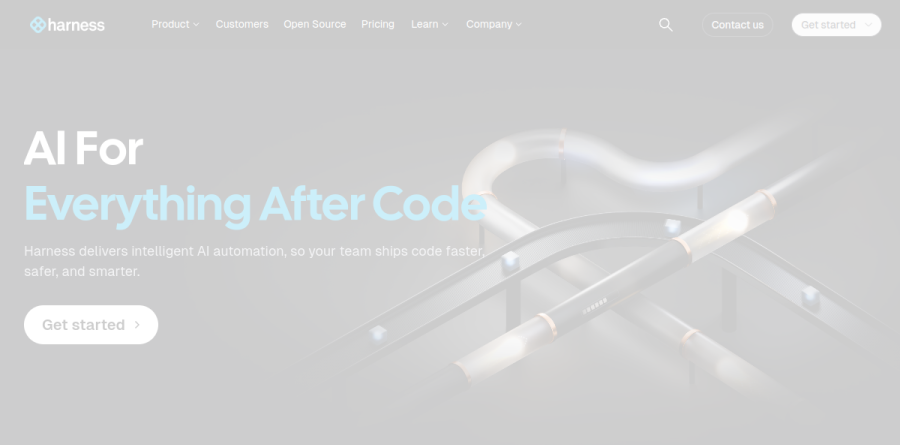
What is Harness?
Harness is a software delivery platform aimed at everything that happens after a developer commits code — building, testing, deploying, releasing, securing, and paying for the infrastructure underneath. It is not one tool but a set of modules — Continuous Integration, Continuous Delivery and GitOps, Feature Management and Experimentation, Cloud and AI Cost Management, Application Security Testing, Internal Developer Portal, Infrastructure as Code Management, and Artifact Registry — which the homepage groups under DevOps and Automation, Testing and Resilience, Security and Compliance, and Cost and Optimization.
The current positioning leans hard on AI; the homepage frames the platform as AI for everything after code. That framing runs through the module names themselves: AI Test Automation, AI SRE, AI Evals, AI Security, and AI DLC Insights sit on the homepage alongside the longer-standing DevOps modules.
Pipelines that build fast and deploy anywhere

On the build side, Harness Continuous Integration leans on three named pieces. Test Intelligence selects only the tests a code change can plausibly affect. Cache Intelligence caches at every step across Gradle, Bazel, Maven, and Docker layers, so incremental builds skip work already done. Harness Cloud supplies hosted build infrastructure with SLSA L3 compliance for teams that would rather not run their own runners. The vendor reports builds up to 8x faster than competing CI tools.
Continuous Delivery and GitOps handles the other half. Canary and blue-green rollouts are configuration choices rather than shell scripts, targets range from Kubernetes and serverless to VMs and mainframe, and teams already running ArgoCD or Flux can centralize them to curb Argo sprawl. AI-assisted verification reads deployment metrics and logs, then triggers rollback when a release misbehaves. Pipelines are editable as drag-and-drop visuals or as YAML.
Releasing features on a separate clock
Feature Management and Experimentation lets Harness split deployment from release. Flags, targeting rules, dynamic configuration, progressive rollouts, and a kill switch let teams deploy code in production without releasing it to customers, which the vendor frames as the basis for safe testing in production. SDKs cover Android, iOS, JavaScript, React, Node.js, Go, Java, .NET, Python, Ruby, and PHP, and flag evaluation happens locally so user data stays inside your systems. A/B testing sits alongside the flags, and warehouse-native experimentation runs experiments directly in your data warehouse using the metrics, SQL, and governed data your team already trusts; integrations pull data in from Google Analytics, mParticle, Segment, and Sentry, and push results out to Datadog, Jira, New Relic, and Sumo Logic.
Governance, security, and the cloud bill

Harness treats compliance as pipeline furniture rather than a review meeting. The Continuous Delivery and GitOps page builds governance into the pipeline itself: Open Policy Agent guardrails so central teams can require things like an approval step on all production deployments, deployment freezes that block releases during sensitive windows, fine-grained role-based access control, and audit trails showing who made a change — which Harness pitches at SOX compliance through clear controls, traceability, and immutable logs of who did what and when. Cloud and AI Cost Management attacks spend from another angle: AutoStopping parks idle VMs and wakes them on demand, Commitment Orchestrator automates reserved instance and savings plan coverage, and Cluster Orchestrator right-sizes Kubernetes nodes with spot orchestration. Attribution reaches individual pods and namespaces, chargeback follows the FOCUS specification, and anomaly detection spans LLM and GPU workloads.
How the plans are structured
Harness publishes three tiers. The Free plan targets individual developers and small teams, and the same section links to Harness Open Source and Litmus Chaos, positioned as a starter platform for managing the software delivery lifecycle. Essentials bundles a DevOps Essentials package — Continuous Delivery and GitOps, Continuous Integration, Infrastructure as Code Management, and Security Testing Orchestration — with standard support. Enterprise drops the bundle, lets you assemble any combination of modules, and adds advanced features, premium support, and a dedicated account manager.
Who should choose Harness
Harness fits platform teams at organizations where delivery has become a discipline of its own — many services, mixed deployment targets, auditors asking questions, and a cloud bill nobody fully explains. Enterprise pricing is aimed at exactly that buyer: any combination of modules, plus advanced features, premium support, and a dedicated account manager. Teams migrating off Jenkins sprawl or stitched-together scripts tend to see the sharpest gain. It is a poor fit for a small team shipping a single application on a managed host, where GitHub Actions plus a hosting provider covers the job with far less overhead; the quote-only paid tiers also make Harness awkward for anyone who needs a number before a demo.
Strengths
- Genuinely free plan: 2,000 monthly Harness Cloud build credits across ~6 modules
- AI copilot (AIDA) auto-builds pipelines and triages failed deployments
- Modular — buy only CI, CD, Feature Flags, CCM, STO or IaCM that you need
- Offered as managed SaaS and as self-hosted/self-managed deployment
Watch out for
- Paid Essentials and Enterprise tiers are quote-only; no public per-developer prices
- Verified deals run ~$48k/year median (range $8.5k–$232k), steep for small teams
- Free-tier cloud credits expire monthly and do not roll over
- Breadth of 15+ modules means a steeper learning curve than single-purpose tools
Key features
| Feature | What it does |
|---|
| Continuous Integration (CI) | Cloud or self-hosted build pipelines with test intelligence and caching; 2,000 free cloud credits/month. |
| Continuous Delivery & GitOps (CD) | Automated deploys with canary/blue-green strategies and AI-driven verification and auto-rollback. |
| Feature Management & Experimentation | Feature flags plus controlled rollouts and A/B experiments (formerly the Feature Flags module). |
| Cloud Cost Management (CCM) | Tracks and optimizes AWS/Azure/GCP/Kubernetes spend with AutoStopping and rightsizing recommendations. |
| Security Testing Orchestration (STO) | Aggregates SAST/DAST/SCA scanner results and enforces security gates inside pipelines. |
| Infrastructure as Code Management (IaCM) | Manages Terraform/OpenTofu workflows with cost estimation, drift detection and governance. |
How Harness compares
| Alternative | How it differs |
|---|
| GitLab | All-in-one DevOps platform with published per-user pricing and a stronger free tier. |
| CircleCI | CI/CD-focused with transparent credit-based pricing, but lacks Harness's cost + feature-flag breadth. |
| Octopus Deploy | Deployment-automation specialist with public per-deployment-target pricing. |
Frequently asked questions
Is Harness free?
Yes. Harness offers a permanent free plan at $0/month for individual developers and small teams, including 2,000 Harness Cloud build credits monthly across about six modules (Code Repository, CI, CD/GitOps, Cloud Cost Management, Feature Management, and Chaos/Resilience Testing). Separately, Harness Open Source is a free, self-hostable code and CI/CD engine.
How much does Harness cost?
Harness doesn't publish paid prices. The Free plan is $0; Essentials and Enterprise are quote-only through sales, using per-developer 'Developer 360' pricing. Third-party verified purchase data shows a median around $48,350/year, ranging from roughly $8,500 to $232,000 depending on modules, team size, and multi-year discounts of 15–30%.
Is Harness open source?
Partly. The core Harness platform is proprietary SaaS, but Harness Open Source (formerly Gitness) is a free, self-hostable code repository and CI/CD engine, and LitmusChaos for chaos engineering is open source. Most enterprise capabilities — the AIDA copilot, advanced governance, and cloud cost — stay in the paid, quote-based tiers.
Harness vs GitLab?
GitLab publishes transparent per-user pricing and bundles source control, CI/CD, and security in one app with a generous free tier. Harness keeps paid pricing behind sales but offers deeper cloud cost management, feature flags, and AI-native delivery. GitLab suits transparency-focused teams; Harness suits enterprises consolidating specialized DevOps modules.
What is the Harness free tier limit?
The free plan gives 2,000 Harness Cloud credits per month. Credits are consumed per build minute multiplied by the resource class, so larger machines burn credits faster. Unused credits expire monthly and don't roll over, while self-hosted runners stay unlimited. It targets small teams; paid tiers add more developers, modules, and support.
Harness ratings on other platforms
Independent user ratings from third-party review sites, linked here for transparency.
These are not our editorial score, are captured on the date shown, and may have changed since.