The full review
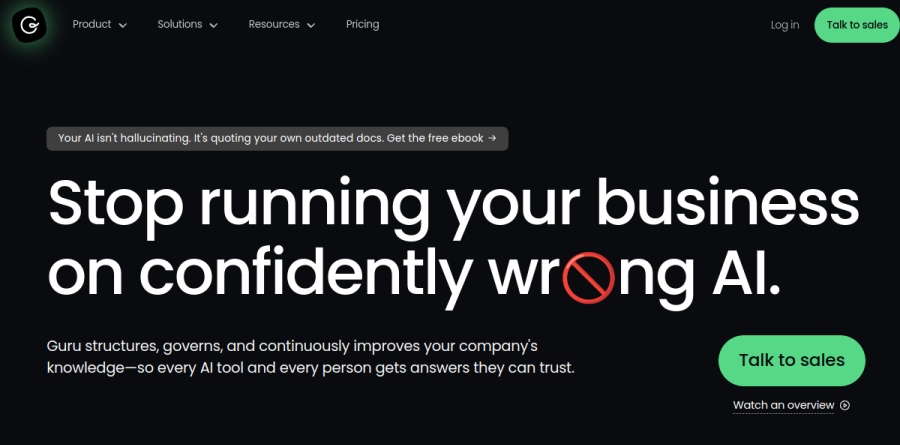
What is Guru?
Guru is an AI knowledge management platform that presents itself as the governed knowledge layer for enterprise AI. Instead of acting as another wiki that quietly rots, Guru structures the material a company already owns, keeps verifying it, and serves it back as cited, permission-aware answers to both people and AI tools.
The framing on the Guru homepage is blunt: the vendor argues teams should stop running a business on confidently wrong AI, and that generic assistants fail because the knowledge underneath them was never governed. Guru responds by treating content quality as a system to automate rather than a chore to assign, covering product documentation, team processes, corporate policies, runbooks, sales playbooks, escalation procedures, and revenue definitions such as ARR and MRR logic.
How Guru keeps knowledge verified
Maintenance is where Guru separates itself. The platform surfaces working signals like conflicting versions detected, duplicates merged, stale SharePoint pages flagged, knowledge gaps identified, and outdated content archived. When a correction lands, Guru propagates it everywhere the fact appears, so fixing something once genuinely fixes it. Content can be auto-verified as usage increases, routed to an expert for review, or quietly unverified when it stops meeting policy.
Guru groups this under what its pricing page calls the AI Knowledge Layer, bundling automated knowledge quality and maintenance, verification workflows, usage signals, and deep research across the knowledge base. Guru's homepage credits those quality automations with taking one customer, Cartwheel Care, from 60 percent of knowledge assessed and verified to 100 percent.
Answers where the team already works

Guru is built for delivery rather than as a destination. Answers arrive through Slack and Microsoft Teams, browser extensions, and a connector catalog the vendor puts at more than one hundred integrations. The Guru integrations directory sorts those connectors into sources you search and places you search from, alongside HRIS Sync and SSO or SCIM options, with Salesforce, Zendesk, Confluence, SharePoint, Google Drive, Jira, HubSpot, BambooHR, and Workday among the named apps.
The sharper move is MCP. Guru runs an MCP server so assistants including ChatGPT, Claude, and Microsoft Copilot can pull from the same governed material without every tool rebuilding permissions from scratch. For companies already juggling several AI products, Guru positions itself as the shared source those tools query rather than a competing chat window.
Governance built for regulated teams
Every answer Guru returns carries citations and lineage, which matters when the reply drives a compliance decision. Permissions inherit from existing systems and are enforced in real time, so an answer scoped by role stays scoped. The Enterprise Governance layer lists SOC 2 Type II, HIPAA, and GxP compliance, SSO and SCIM with role-based access, Data Loss Prevention masking, encryption at rest and in transit, and centralized audit logs spanning every consumer of knowledge, human or machine. Guru also states that customer data never trains its AI models.
The expertise layer inside the package
An unusual part of a Guru engagement is that it is not sold purely as software. Alongside the platform sits an AI and KM Strategy Team of solution engineers who design the knowledge architecture, configure and tune agents, handle integration setup and rollout support, supply a change management playbook, and run ongoing optimization reviews. The vendor frames this as a launchpad instead of a dependency, with customers keeping day-to-day control of their environment. Nonprofits have a separate route through Guru for Good, a Give First initiative offering reduced cost to eligible 501(c)(3) organizations.
Who should choose Guru
Guru fits mid-market and enterprise teams where a wrong answer is expensive, which usually means support, IT, HR, compliance, and revenue operations, and especially those rolling out AI assistants on top of a messy documentation estate. If audit trails, inherited permissions, and cited answers sit on your requirements list, Guru is a strong candidate, and the bundled strategy team meaningfully lowers the odds of a stalled rollout.
It is not ideal for small teams that simply want a tidy, inexpensive wiki. Guru is scoped as an enterprise engagement with no self-service plan published on its pricing page, so a five-person startup will find the model heavier than the problem warrants.
Strengths
- AI search returns cited, permission-aware answers from one governed source of truth
- Browser extension and Slack surface knowledge inside tools employees already use
- Verification workflows (assigned experts, scheduled reviews) keep content trustworthy
- Strong enterprise compliance: SOC 2, HIPAA, GxP plus 100+ integrations
Watch out for
- Every reader needs a paid seat, so cost scales with full headcount, not just authors
- 10-seat minimum sets a real floor of $250/mo, not the advertised $25
- No permanent free tier and no public or customer-facing knowledge base
- Enterprise pricing is opaque; the official page pushes 'talk to sales' over transparent tiers
Key features
| Feature | What it does |
|---|
| AI Knowledge Agents | Cited, permission-aware answers via AI search and chat across your connected sources |
| Verified Knowledge Base | Assigned experts and scheduled reviews keep every card trusted and current |
| Customizable Intranet | Role-based homepage, announcements, and access controls for each team |
| Browser Extension & Slack | Surfaces knowledge in-context without leaving the tools employees already use |
| Analytics & Gap Insights | Usage monitoring flags stale content and unanswered questions |
| 100+ Integrations | Connects to Salesforce, Zendesk, Jira, Slack, Google Workspace, and more |
How Guru compares
| Alternative | How it differs |
|---|
| Confluence | Cheaper document-first wiki (~$5-11/user/mo); weaker AI search and verification |
| Notion | Flexible all-in-one workspace with AI; less governance and in-app answer delivery |
| Glean | Enterprise AI work assistant with broader search; typically pricier and heavier to deploy |
Frequently asked questions
How much does Guru cost in 2026?
Guru's self-serve All-in-One plan runs $25 per user per month billed annually, or $30 month-to-month. A 10-seat minimum applies, so the real floor is $250/month. Enterprise pricing is custom and usage-based, negotiated with sales; third-party data shows a median contract near $37,800 per year. There is no permanent free tier.
Does Guru have a free plan?
No. Guru discontinued its older free tier and now offers only a 30-day free trial of the self-serve plan. After that, every user who needs read access requires a paid seat starting at $25/month, with a 10-seat minimum ($250/month). Note Guru is internal-only, with no public or customer-facing knowledge base included.
Is Guru worth it?
Guru is worth it for teams that use verified, AI-searched answers daily, especially support, sales, and operations. At $25/user/month with a 10-seat minimum, small teams pay at least $250/month, and because every reader needs a seat, costs track headcount rather than authors. Budget-focused teams may prefer a cheaper wiki like Confluence.
What is Guru used for?
Guru is an internal AI knowledge management platform. It centralizes scattered company information into a verified single source of truth, then lets employees ask AI agents for cited, permission-aware answers via a browser extension, Slack, or a customizable intranet. It connects to 100+ tools like Salesforce, Zendesk, and Jira to surface knowledge in context.
Guru vs Confluence: which is better?
Confluence is a cheaper, document-heavy wiki (roughly $5-11 per user per month) built for structured project documentation. Guru costs more at $25/user/month but adds verification workflows, AI search with cited answers, and in-app delivery through a browser extension and Slack. Choose Confluence for docs on a budget; choose Guru for trusted, surfaced answers.
Guru ratings on other platforms
Independent user ratings from third-party review sites, linked here for transparency.
These are not our editorial score, are captured on the date shown, and may have changed since.