The full review
What is Gumroad?
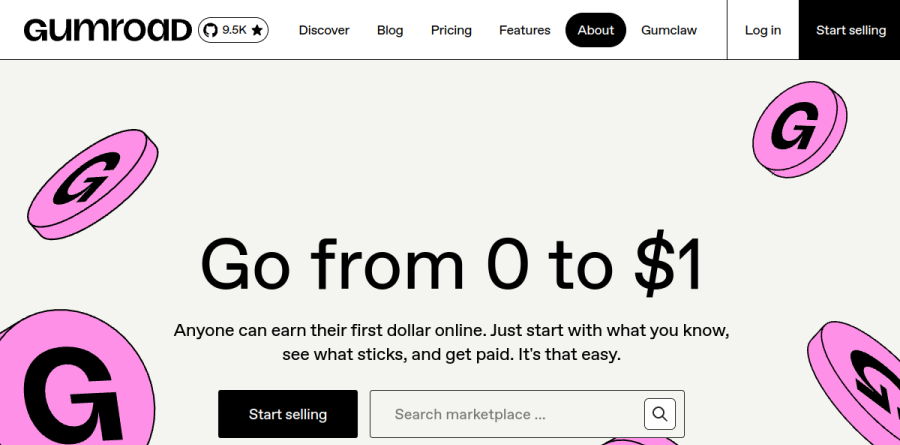
Gumroad is a checkout and storefront platform for independent creators selling digital goods, which the vendor's pricing FAQ lists as digital products, e-books, courses, tutorials and memberships. It lands in the course platform category, but the product is broader than a course builder, handling the product page, the payment, file delivery, and payout in one account. The homepage pitch is deliberately modest: earning your first dollar online.
The structural difference from most competitors is the fee model. Gumroad charges nothing to open a shop and instead takes a percentage of each sale, so a quiet month costs a seller nothing. The vendor also reports that since January 2025 it operates as Merchant of Record, handling sales tax collection and remittance worldwide so creators avoid registering in every jurisdiction themselves.
Setting up a Gumroad storefront

The Customizable Options block on the Gumroad features page centers on a flexible page editor, which is how sellers assemble a product page without touching code. You can link a custom domain so the store sits on your own address, and Gumroad supports embedding its payment platform into an existing site, useful when you already run a blog and want checkout to happen there rather than sending buyers elsewhere. A follow button lets visitors subscribe before they ever buy, turning casual traffic into a list you can sell to later.
The homepage sums up the payment options as a choice between one-time, recurring, or fixed-length payments in the currency of your choice. Simple memberships and subscriptions run monthly, quarterly, biannually, or yearly, so one creator can package a cohort course as a single purchase and a community as a membership inside the same storefront. Pay-what-you-want pricing suits sellers still testing demand, while multiple currency support and VAT handling cover cross-border buyers. License key generation matters for anyone shipping software rather than documents.
Delivering courses and downloads
For course sellers, the features page promises that payments are secure and smooth so customers can read, listen to, or watch their purchase immediately. The Sell multiple versions feature lets buyers pick from PDF, ePub and Mobi, with the option to charge more for lossless audio, which suits an author releasing a book in every format readers ask for. DRM protection is offered for creators worried about redistribution, though it acts as a deterrent rather than a lock.
Gumroad treats the customer list as the asset rather than the transaction. Sellers can import an existing email list, send email broadcasts, build automated workflows that trigger follow-up messages, and publish posts that push updates to past buyers. Sales analytics show what is converting, and follower and customer data export keeps that list portable, which is a genuine point in Gumroad's favor for anyone wary of lock-in. The company also publishes its codebase openly on GitHub, unusual in this category.
Direct sales versus Gumroad Discover

Two routes to a buyer exist, and they carry different rates. The Direct sales path applies when someone reaches your product through your own link, profile, or marketing. Gumroad Discover is the built-in marketplace, where the platform surfaces your product to shoppers already browsing a category, and that traffic costs more per sale because Gumroad does the acquisition work. Treating Discover as a paid channel rather than free exposure is the honest framing; the pricing page sets out both rates and states that Gumroad charges no monthly fee, deducting a small percentage of every sale instead.
Who should choose Gumroad
Gumroad fits creators who sell irregularly or are still validating an idea: solo course creators, authors, designers selling templates, indie developers, and anyone whose income is lumpy enough that a fixed monthly bill stings. The absent subscription and the Merchant of Record tax handling remove two real barriers to starting. It is not ideal for high-volume sellers with established audiences, where a cut of every sale eventually costs far more than a flat monthly plan, nor for course businesses needing cohort management, graded assessments, or granular drip scheduling, since Gumroad's course hosting is deliberately simple.
Strengths
- No upfront or monthly cost — you pay only when you actually sell
- Acts as Merchant of Record, automatically collecting and remitting global sales tax/VAT
- Extremely fast to set up with a minimal learning curve
- Handles many product types (courses, ebooks, memberships, license keys, physical goods) in one account
Watch out for
- Not a true LMS — course tools lack quizzes, robust drip scheduling, completion certificates and student community
- 10% + $0.50 plus separate payment processing becomes expensive at higher sales volume
- Gumroad Discover marketplace takes a steep 30% per sale
- Limited branding and customization of product pages and checkout
Key features
| Feature | What it does |
|---|
| Merchant of Record | Since January 2025 Gumroad is the seller of record on every transaction, automatically handling sales-tax and VAT collection and remittance worldwide. |
| Pay-as-you-sell pricing | No subscription: fees are deducted per sale, so an idle store costs nothing. |
| Multi-format products | Sell courses, ebooks, memberships/subscriptions, license keys with PDF stamping, and even physical goods from one dashboard. |
| Discover marketplace | Optional built-in audience that surfaces your product to Gumroad shoppers for extra reach, at a higher 30% fee. |
How Gumroad compares
| Alternative | How it differs |
|---|
| Teachable | Dedicated course platform with quizzes, certificates and a real student experience; charges monthly plans rather than per-sale fees. |
| Podia | All-in-one creator platform bundling courses, memberships, email and a website for a flat monthly price. |
| Payhip | Closest direct rival — a simple digital-product storefront with a free tier and lower flat fees that scale better at high volume. |
Frequently asked questions
Does Gumroad charge a monthly fee?
No. Gumroad has no subscription plans or tiers. You pay 10% + $0.50 per direct sale plus payment processing (around 2.9% + $0.30 for cards), and 30% on sales that come through its Discover marketplace. If you sell nothing, you pay nothing.
Is Gumroad a good platform for online courses?
It's fine for simple courses and excellent for beginners who want to launch fast, but it isn't a full LMS. It lacks the quizzes, drip scheduling, completion certificates and community tools that dedicated platforms like Teachable, Thinkific or Podia provide.
Gumroad ratings on other platforms
Independent user ratings from third-party review sites, linked here for transparency.
These are not our editorial score, are captured on the date shown, and may have changed since.