The full review
What is Kajabi?
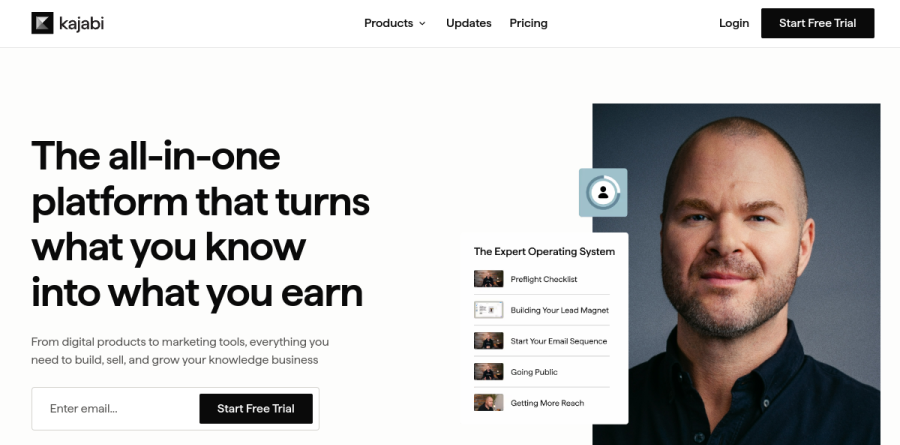
Kajabi is an all-in-one business platform for people who sell what they know. The vendor describes it as the operating system for human expertise, and the product line follows that framing: courses, coaching programs, communities, memberships, newsletters, podcasts, and digital downloads are created, priced, and delivered from a single account instead of being stitched across separate services.
Around those products sits the rest of the business. Kajabi bundles websites, email marketing, funnels and automations, checkout, and analytics into one subscription, with plans named Starter, Basic, Growth, and Pro scaling on products, contacts, admin users, websites, and communities. The homepage is blunt about the target buyer: experts paying for five tools that do not talk to each other.
Course delivery built around completion
The Courses product is organized around guided learning rather than a video dump. Kajabi supports modular curriculum design, drip content and scheduled releases, assessments and knowledge checks, and progress tracking with completion insights, so a creator can see where students stall. Video transcriptions and translations plus cohort support appear in the plan comparison, which also lists the Kajabi Customer App and a Branded Mobile App the vendor values at $199/mo.
Coaching without the operational chaos

Coaching is where Kajabi separates itself from simple course hosts. Sessions schedule natively, with clients booking from your availability or connecting an external calendar such as Calendly or Acuity, and live video runs inside the platform for rooms of up to 200 participants. Coaches attach session outlines and resources, upload pre-recorded sessions, keep private notes on each client, and rely on automated confirmations and reminders. Packages sell as single sessions, tiered bundles, or recurring payments, so an offer and its billing stay in one place.
Kajabi Payments and the checkout layer

Kajabi Payments handles the money side without a separate merchant relationship. It takes major cards plus Apple Pay, Google Pay, Afterpay, and Klarna, and checkout forms embed on any page so buyers never bounce to an unfamiliar cart. One cart can carry a course, a membership, and coaching together, with order bumps, upsells, downsells, coupons, and pay-what-you-want pricing available on offers. Kajabi Sales Tax calculates and collects at checkout then generates filing reports, with QuickBooks Online and Xero connections for bookkeeping. Outside processors still work, though the platform fee on third-party providers shrinks as you climb the plan ladder.
Marketing automation and the new AI tier
Kajabi Email Marketing covers broadcasts and multi-touch automated sequences from one visual editor with live preview and a template library. The vendor reports a 99 percent deliverability rate and more than ten billion emails sent annually across the platform. Behavior-based automation triggers, pre-built funnel Pipelines, and landing pages tie the email layer to your offers and funnels so follow-up runs automatically.
The newer layer is AI. Cofounder is an in-product business partner that drafts plans, offers, sales pages, and email sequences; Expert Agents are pitched as AI teammates trained on your own content; Kajabi MCP opens the account to outside AI tools; Amplify lets you market to the 551 million contacts in the expert network already inside Kajabi; and Backstage assembles personalized programs from material you already published. AI credits are metered per plan, so heavy users should check the allowance.
Who should choose Kajabi
Kajabi fits the established expert: a coach, educator, or practitioner with an audience, real revenue, and enough moving parts that paying separately for email, hosting, checkout, and a CRM has become a chore. Growth and Pro suit anyone running several offers, a team of admins, or a sizable contact list, and the coaching and community tooling rewards businesses built on relationships rather than one-off downloads.
It is the wrong pick for someone validating a first idea with no revenue yet, or for a creator who only needs somewhere to park one course, because the entry price assumes you are replacing a stack rather than starting one. The same caution applies if you already like your marketing platform, since you would pay twice for the layer that makes Kajabi worth it.
Strengths
- Genuinely all-in-one: courses, email marketing, funnels, website, checkout, and community in a single tightly-integrated tool
- 0% platform transaction fee on sales — you only pay payment processing, unlike some rivals that clip every sale
- Robust built-in email marketing with automations and segmentation that can replace a separate ESP
- Polished, reliable platform with a branded member mobile app and strong uptime
Watch out for
- Expensive with no free or cheap tier since the ~$89 Kickstarter plan was pulled in Jan 2026 — entry is now $143–$179/mo
- January 2026 price restructure raised Growth and Pro annual rates significantly (Growth $159→$199, Pro $319→$399)
- Contact caps (2,500 on Basic) can force costly upgrades as an email list grows
- Course-authoring depth (quizzing, SCORM, granular LMS controls) trails dedicated LMS platforms; third-party processors add a 0.5–2% surcharge
Key features
| Feature | What it does |
|---|
| Course & digital product builder | Drag-and-drop builder for courses, coaching, memberships, podcasts, and downloads with customizable themes. |
| Email marketing & automation | Native broadcasts, sequences, segmentation, and visual automations tied to purchase and behavior triggers. |
| Sales funnels & checkout | Prebuilt 'Pipeline' funnels, landing pages, order bumps, and upsells via Kajabi Payments with 0% platform fee. |
| Communities & branded app | Member communities plus a white-labeled iOS/Android app so students access content under your brand. |
How Kajabi compares
| Alternative | How it differs |
|---|
| Teachable | More affordable course-focused platform; charges transaction fees on lower tiers but easier entry cost. |
| Thinkific | Strong dedicated LMS with a free plan and no transaction fees; weaker built-in marketing than Kajabi. |
| Podia | Cheaper all-in-one for courses, downloads, and email; simpler and lighter but less powerful automation. |
Frequently asked questions
Does Kajabi have a free plan?
No. Kajabi offers a 30-day free trial but no permanent free tier. The cheapest ongoing option is the Basic plan at $143/mo billed annually (or $179 month-to-month).
Does Kajabi charge transaction fees on course sales?
Kajabi takes a 0% platform fee on all plans. You only pay payment processing — 2.7–2.9% + $0.30 via Kajabi Payments, or a 0.5–2% surcharge if you use a third-party processor like Stripe.
Kajabi ratings on other platforms
Independent user ratings from third-party review sites, linked here for transparency.
These are not our editorial score, are captured on the date shown, and may have changed since.