The full review
What is Dice?
Dice is a job board built exclusively for the technology industry. Instead of serving every profession, it concentrates on engineering, data, cloud, cybersecurity and AI roles, and it splits into two distinct products: a free side for technologists looking for work, and a paid side for employers and recruiters filling technical requisitions.
For candidates the entry point is a free profile rather than a one-off application, and Dice pitches it as the way to find and filter jobs that match your skills, experience and career goals. For employers, Dice sells job slots and candidate database access through named plans, with a services arm handling contract and permanent placement. The vendor reports more than 8.2M tech professionals on the platform, over 5k companies hiring through it, and roughly 200k jobs posted monthly.
What technologists get from Dice
Searching on Dice feels narrower than a generalist board, which is the point. Listings are technical by default, and the browse rails are cut by job title, skill and remote status rather than by the generalist categories a broad board would lead with. Dice reports that 32% of its members are not found on generalist platforms.
Beyond search, Dice runs a substantial Career Advice section organized into Job Hunting, Resume Help, Interview Tips, Career Path, Career Growth and Diversity Equity and Inclusion, alongside Dice Daily and the Tech Connects Podcast. It reads as genuine editorial rather than thin filler, which gives the free Dice profile standalone value for anyone planning a pivot or benchmarking a market.
Inside the Dice Employer Experience

The recruiter product is branded the Dice Employer Experience, which the vendor describes as a recruiter-first platform with AI-powered tools, smarter search and streamlined workflows. It bundles Candidate Sourcing against the member database, tech job posts, and Branding & Advertising for employer brand campaigns. Recruiters work inside the Dice Recruiter Hub, with a Dice Employer App for sourcing away from a desk.
Plans follow a slots-and-views model. Single Job Slot is a one-off 30-day posting for occasional hiring. Starter adds several job slots, a single user seat and a monthly candidate-view allowance. Standard raises both, introduces a second seat with shared candidate views, and layers on Branded Jobs, a branded company profile, a dedicated account manager and a client success partner. Talent Solutions sits above them for contract staffing, contract-to-hire, permanent placement and retained services.
Fitting Dice into an existing hiring stack
Dice does not assume it will be the only system a recruiting team touches. It advertises integrations with Bullhorn, Greenhouse, Workday, JobDiva, Ceipal and Oorwin, which matters most for agencies whose recruiters live inside an applicant tracking system all day and will not tolerate rekeying candidate records.
That integration list is a useful tell about who Dice is built for. Bullhorn, JobDiva and Ceipal are staffing-agency systems, and their presence alongside Contract & Perm Sourcing Services confirms a lean toward agency and contract recruiting as much as in-house corporate hiring.
The AI skills positioning
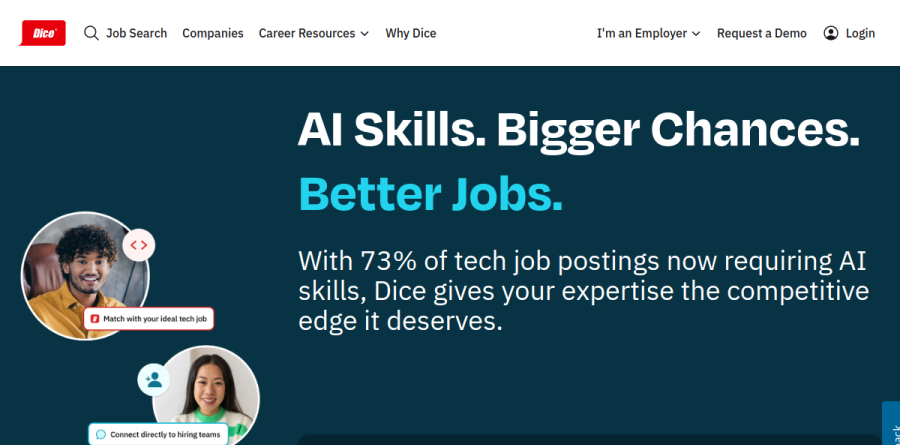
Dice has rebuilt its public messaging around AI hiring, leading with the idea that AI skills unlock better jobs. The vendor reports that 73% of tech postings now require an AI skill, cites 380% growth in such postings since 2024, and tells employers that 97% of companies on Dice see an applicant within 24 hours. Treat those as marketing figures rather than independent research. The underlying editorial choice is still sound: a tech-only board keeps its role taxonomy and skill filters closer to current stacks than a general board manages.
Who should choose Dice
Dice suits staffing agencies and in-house recruiters hiring technologists on a steady cadence, especially for the contract, contract-to-hire and permanent placement work its Talent Solutions plan is built around. Teams that want employer branding bundled with postings should start at Standard rather than the entry plans; anyone testing the water can buy a Single Job Slot without a contract. Technologists lose nothing by keeping a free profile.
It is a weak fit for hiring outside technology, and for small teams filling one or two roles a year, where per-slot economics are hard to justify against cheaper general boards.
Strengths
- Genuinely tech-specialized listings with granular, skills-based filtering
- Completely free for job seekers — search, apply, and alerts with no paywall
- Strong reach into enterprise IT roles (sysadmin, network, DBA, security, DevOps)
- Established brand with a large, tech-focused candidate database recruiters value
Watch out for
- Job seekers report spam, aggressive recruiter outreach, and some fake listings after making a profile public
- No modern AI matching; interface feels dated next to LinkedIn Jobs and newer platforms
- Expensive for employers relative to general boards, and heavily US-centric
- Losing mindshare among startups and younger tech professionals who favor LinkedIn/Wellfound
Key features
| Feature | What it does |
|---|
| Tech-focused job search | Filters tuned to IT skills, employment type, clearances, and remote work rather than generic keywords |
| Candidate database & search | Recruiters search and contact tech candidates, with monthly candidate-view allowances scaled by plan |
| Job-slot subscriptions | Recurring posting slots promoted across Dice's network, plus optional promoted-listing boosts |
| Career resources & salary data | Annual Tech Salary/Job reports and skill insights help candidates benchmark pay and demand |
How Dice compares
| Alternative | How it differs |
|---|
| LinkedIn Jobs | Broader reach, networking, and better AI matching, but far less tech-pure than Dice |
| Indeed | Largest listing volume across all industries; weaker tech-specific filtering and signal |
| Wellfound | Startup and early-stage tech roles, often free for employers; thinner enterprise coverage |
Frequently asked questions
Is Dice free for job seekers?
Yes. Creating a profile, searching, filtering, setting alerts, and applying to jobs are all free. Only employers and recruiters pay, for job postings and candidate-database access.
How much does Dice cost employers in 2026?
The official site lists a Single Job Slot at $399, a Starter plan at $549/mo (annual) or $649/mo, and a Standard plan at $749/mo (annual) or $899/mo, with custom enterprise pricing available. Some third-party sources still cite legacy per-post rates.
Dice ratings on other platforms
Independent user ratings from third-party review sites, linked here for transparency.
These are not our editorial score, are captured on the date shown, and may have changed since.