The full review
What is Codeforces?
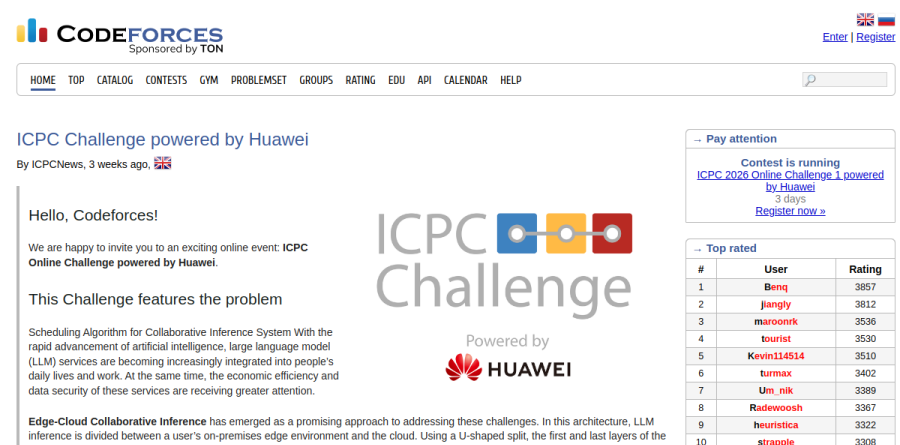
Codeforces is a contest platform and a social network for competitive programming, running since 2010 under founder Mike Mirzayanov. Its own FAQ describes the project as one joining people interested in programming contests: a site where rounds are held regularly, where participant skill is reflected by a rating, and where past contests double as preparation material. The top navigation lays the whole product out in a single strip - Home, Top, Catalog, Contests, Gym, Problemset, Groups, Rating, EDU, API, Calendar and Help.
During our visit an ICPC 2026 Online Challenge powered by Huawei was counting down, announcements covered Codeforces Round 1117 (Div. 2) and Educational Codeforces Round 193, and the sidebar ranked top rated users beside a fast-moving Recent actions feed of community posts.
How a Codeforces round works
The FAQ states that participation is free and open to everybody, with roughly six contests organized each month. Under standard Codeforces rules your submissions face only a small set of pretests during the round. Lock a problem and you gain the right to look through other contestants' sources and suggest tests on which those solutions fail; successful hacks add points, failed attempts subtract them, and problem value decays as the clock runs.
Educational Codeforces Rounds and Div. 3 rounds use extended ICPC rules instead: a ten minute penalty per wrong submission, then a twelve hour open hacking phase in which anyone can copy and break accepted code, followed by a rejudge. Announcements credit every tester by handle and later link an editorial, though rounds run on educational rules carry no score distribution at all.
Problemset, Gym and virtual contests
The Problemset page carries most of the training load. It archives problems from past rounds with a difficulty number on each row, from 800 for the gentlest Div. 3 openers up past 3400 for finals-grade work, alongside tags such as data structures, dp, greedy and constructive algorithms, and a counter of how many people solved it. Filtering by band and tag turns the archive into a self-paced ladder.
Gym is a second archive: contests prepared by universities and communities worldwide, labelled by type - Official ICPC Contest, Training Camp Contest, School/University/City/Region Championship - and by format, ICPC or IOI. Each listing offers Enter and Virtual participation, so a team can rerun an old regional under authentic timing, and a Mashups tab lets coaches assemble custom sets.
Codeforces EDU and community learning
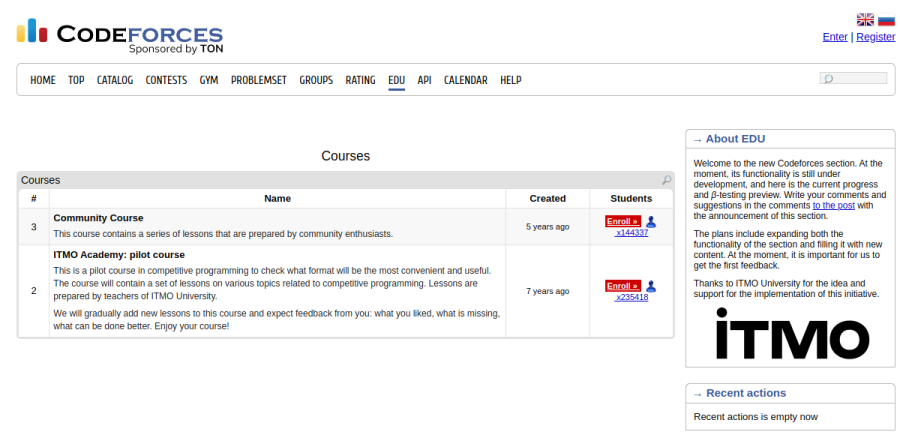
EDU is the structured teaching arm. Codeforces presents the section as still under development, credits ITMO University for the idea and support, and lists two tracks: the ITMO Academy pilot course and a Community Course assembled from lessons by community enthusiasts. The ITMO Academy pilot course shows about 235,000 enrolled students and the Community Course about 144,000.
Editorials follow nearly every round, and the Catalog gathers community tutorials on subjects like dynamic segment trees - where much of the real teaching value lives.
Rating, divisions and contribution
The FAQ calls Codeforces rating a modification of Elo, recalculated after each rated round, and it drives the color-coded handles the community recognizes on sight. It also sets the Div. 1 boundary at 1900, though announcements set their own rated ceiling; several recent Div. 2 rounds were rated for participants below 2100, and Div. 3 and Div. 4 rounds now serve newer competitors, with Div. 3 official standings restricted to trusted participants to curb unsporting behaviour. A separate contribution score rates how useful your posts are; Codeforces candidly calls that system imperfect.
Who should choose Codeforces
Codeforces fits anyone serious about algorithms: ICPC and olympiad competitors, students who want an objective external rating, and self-taught engineers chasing genuine problem-solving depth rather than memorized patterns. Coaches get real leverage from Groups, Gym and Mashups, and the public API opens the data to tool builders. None of it sits behind a paywall - the site offers no paid plan, and the FAQ states that participation is free and open to everybody.
It is a poor fit if you want a guided beginner curriculum, a polished interface, or interview practice with hints and hand-holding - the layout is dense and dated, statements are terse and mathematical, and nothing here touches web development, systems or production engineering. Treat Codeforces as a gym for algorithmic thinking, not a bootcamp.
Strengths
- Completely free with no feature paywalls or usage caps
- Massive, high-quality problem archive with official editorials
- Respected Elo-style rating that objectively benchmarks skill
- Frequent live contests (roughly 6+ per month) across skill divisions
Watch out for
- Steep learning curve; unwelcoming for absolute beginners
- Dated, cluttered UI with occasional server slowdowns
- Focused on contest algorithms, not job-interview or career prep
- No structured courses, certificates, or guided learning paths
Key features
| Feature | What it does |
|---|
| Rated contests | Regular timed rounds split into divisions, with live standings, hacking phases, and rating changes. |
| Problem archive | Thousands of past-contest problems, filterable by tag and difficulty, with editorials and community solutions. |
| Virtual contests | Re-run any past contest under original time limits to simulate live conditions for practice. |
| Polygon & Groups | Free tooling to author, test, and host problems, plus private groups for classes and training teams. |
How Codeforces compares
| Alternative | How it differs |
|---|
| LeetCode | More interview- and job-focused, with a paid Premium tier; less pure competitive programming. |
| AtCoder | Japanese contest platform with cleaner UX and beginner-friendly ABC rounds; smaller archive. |
| HackerRank | Skills certifications and employer assessments; weaker as a serious competitive-programming ladder. |
Frequently asked questions
Is Codeforces really free?
Yes. Every feature, including contests, the full problem archive, editorials, and the rating system, is free. Donations are voluntary and grant no extra benefits.
Is Codeforces good for coding-interview prep?
Indirectly. It sharpens algorithmic and problem-solving skills, but it is built for contests, not interviews. LeetCode or HackerRank map more closely to typical interview formats.
Codeforces ratings on other platforms
Independent user ratings from third-party review sites, linked here for transparency.
These are not our editorial score, are captured on the date shown, and may have changed since.