The full review
What is Codewars?
At its core, Codewars is a browser-based coding practice platform built around short exercises called kata, each one authored and refined by the community rather than by a curriculum team. The homepage frames the pitch as achieving mastery through challenge, and the mechanics back that up: you pick a kata, write a solution in one of the 55+ supported languages, and run it against a test suite until every case passes.
What separates Codewars from a tutorial site is the ranking layer sitting on top. Every kata carries a difficulty from 8 kyu at the gentlest end to 1 kyu at the hardest, and your own rank climbs as you clear tougher problems. The vendor reports more than 12K kata created by its community and over 1M completed each month.
Inside the kata library
The Kata Library is the main surface, and you can browse it before signing up. Filters cover language, approval status (Approved, Beta, or both), your own progress, kyu rank, and a deep tag list spanning Algorithms, Fundamentals, Data Structures, Databases, Cryptography, Games, and dozens more. Sort options run from Popularity and Most Completed through Hardest, Easiest, and Low Satisfaction, the last of which is a practical way to steer around poorly received exercises. Beta-tagged languages such as Prolog, Nim, and Raku sit beside stable Python, Java, and Rust tracks.
Ranks, honor, and leaderboards
Progress on Codewars is measured in honor, which the platform awards for reaching higher dan and kyu ranks and for activities such as collecting up votes on kata, solutions, and comments. The Leaderboards page states plainly that publishing a kata is worth more honor than solving one, a rule that nudges strong users toward contributing instead of only consuming. Leaderboards split into Overall, Completed Kata, Authored Kata & Translations, and Ranks views, and the table carries Position, Rank, User, Clan, and Honor columns.
Learning from other solutions
The real payoff arrives after you pass. Codewars opens the community solutions for that kata, letting you compare your working answer against terser, faster, or frankly stranger approaches from everyone else who solved it. Kumite extends the idea with freestyle sparring, where members take turns remixing and refactoring code posted by others. Codewars links out to a Discord server and a GitHub repository from its site footer, and any member can author and publish original kata.
What Codewars Red adds
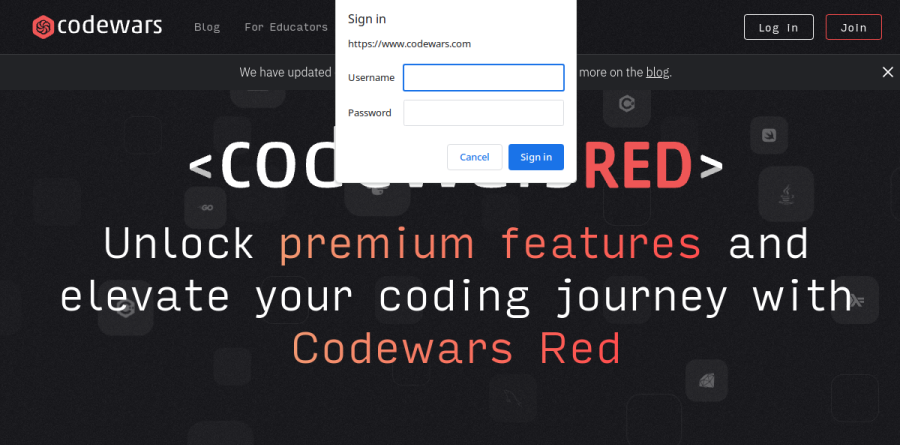
Codewars Red is the optional subscription, sold as Monthly, Semi-annual, and Annual plans. The listed benefits are Enhanced Statistics, an Ad-Free Experience, the ability to compare your progress to peers, access to beta features, and an exclusive profile badge. Worth noting: Red reads as a comfort and insight upgrade rather than a content gate, since the kata library, rank progression, and leaderboards all remain reachable without a subscription. The subscription page lists Monthly at $5, Semi-annual at $24, and Annual at $40.
Classrooms and hiring teams
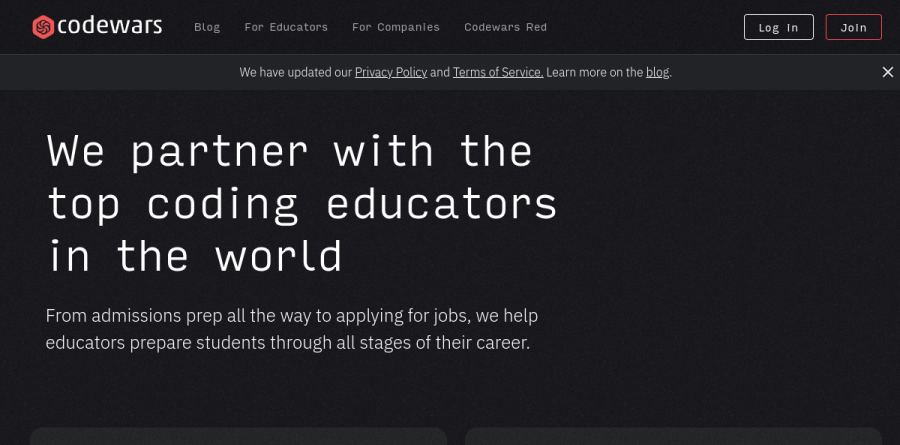
Beyond solo practice, Codewars runs Educator Partnerships for instructors who want to fold kata into coursework, alongside Assess Students, Skill Assessments, and Find Candidates paths aimed at schools and employers. The site notes it is built on Qualified.io and now operates under Andela, which explains the assessment plumbing sitting under the gamified front end. Be aware that the Partner Schools directory currently states "No bootcamps available at this time," though the partnerships page itself showcases schools including Thinkful, Le Wagon, General Assembly, and MIT.
Who should choose Codewars
Practically speaking, Codewars suits self-directed developers who already know some syntax and want volume: daily reps on algorithms, data structures, and language fluency. It is especially strong for engineers picking up a second or third language, because re-solving a familiar problem in unfamiliar syntax isolates the grammar from the logic. Instructors get a low-friction homework source, and competitive coders get leaderboards worth chasing. It is not ideal for absolute beginners, though, since there is no structured course path and community-authored kata assume you can already read a spec and interpret a failing test.
Strengths
- Core platform is genuinely free — thousands of community kata across 55+ languages with no paywall on the actual practice
- Kyu-rank and honor progression is motivating and low-pressure; you advance by completing challenges, not by beating others on a leaderboard
- Comparing your solution against top-voted community answers after each kata is a fast, practical way to learn idiomatic patterns
- Unusually broad language support, including Haskell, Clojure, Elixir, Rust and Kotlin that LeetCode and HackerRank often omit
Watch out for
- Red's paid perks are thin — enhanced stats, ad removal, peer comparison and a cosmetic badge, none of which touch the core learning experience
- Kata are community-authored, so quality and difficulty labeling vary and moderation is inconsistent
- No structured curriculum or guided learning paths; you self-navigate a pile of isolated challenges
- Weak for FAANG-style interview prep — problems skew easier than LeetCode's hard DSA sets and aren't company-tagged
Key features
| Feature | What it does |
|---|
| Kata challenges | Bite-sized coding puzzles ranked 8 kyu (beginner) to 1 kyu (expert), solved in the browser with test-driven feedback |
| Kyu rank & honor system | Gamified progression that awards honor and raises your rank as you clear higher-difficulty kata |
| 55+ languages | Practice in a very wide range of languages, from mainstream to niche functional and systems languages |
| Community solutions | After solving, view, upvote and compare against other developers' approaches to the same kata |
How Codewars compares
| Alternative | How it differs |
|---|
| LeetCode | Better for technical-interview prep, with company-tagged questions and the hard DSA problems FAANG interviews actually use |
| Exercism | 100% free and open-source, with volunteer human mentor feedback across 80+ language tracks |
| HackerRank | Stronger for skills certifications and employer-facing assessments rather than casual practice |
Frequently asked questions
Is Codewars free?
Yes. The entire core platform — all kata, 55+ languages, ranks, honor and community solutions — is free. The optional Codewars Red subscription only adds statistics, an ad-free experience, peer comparison, beta access and a profile badge.
How much does Codewars Red cost?
As of July 2026, Red is $5 billed monthly, $24 billed every 6 months (Save 20%), or $40 billed annually (Save 30%), which works out to about $3.33/month.
Codewars ratings on other platforms
Independent user ratings from third-party review sites, linked here for transparency.
These are not our editorial score, are captured on the date shown, and may have changed since.