The full review
What is CloudZero?
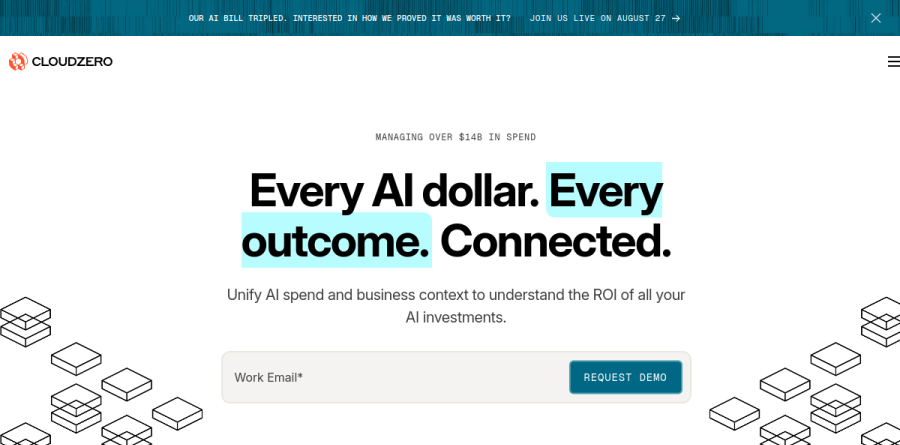
This is a cloud and AI cost intelligence platform for teams that need to know not just how much they spend, but what each dollar produces. CloudZero now positions itself as the AI ROI Company, promising to unify AI spend with business context so teams can measure the return on AI investments. It ingests billing and telemetry from cloud providers, Kubernetes clusters, data platforms, and model vendors, then maps it onto business dimensions.
What separates the product from a native billing console is the allocation layer. Rather than stopping at account, service, and tag, CloudZero pushes spend down to customer, product, feature, team, and model, then exposes it at hourly granularity through Explorer and Analytics.
How CloudZero allocates cloud and AI spend
Two named engines carry the load. CloudZero AnyCost ingests billing data and normalizes it into a common data model, while CostFormation allocates that spend to the business units you define. The vendor reports that CostFormation allocates 100% of your spend regardless of tagging quality, so nothing is left sitting in an unallocated bucket.
The Kubernetes page argues that allocation across pods, clusters, and namespaces works regardless of labeling quality. On shared multi-tenant clusters, where tagging discipline never quite arrives, that is the difference between a report engineers trust and one they ignore.
Explorer, Analytics, and the daily workflow
Engineers use Explorer to dig into spend interactively, filtering by dimension toward a root cause, while Analytics turns those views into dashboards for finance and leadership. Streaming Telemetry feeds the platform continuously instead of waiting for a monthly invoice, which is what makes Anomaly Detection useful: a spike surfaces while someone can still act. Budgets and Forecasting close the planning loop.
CloudZero states that the subscription includes unlimited cost sources, users, dimensions, and dashboards, so every engineering team can hold its own view rather than competing for seats.
AI Hub brings cost analysis into the editor

AI Hub exposes cost analysis through natural language, backed by specialized skills and a library of ready-made prompts organized by role, and runs inside coding environments such as Cursor and Claude Code rather than demanding a separate dashboard login.
The vendor reports that AI Hub pulls context from GitHub, Jira, Slack, PagerDuty, and Datadog to trace a cost movement back to the deploy or incident behind it, returning auditable investigations instead of a chart you must interpret yourself.
Unit costs and margin visibility

Cost per customer, per product, per feature, and per team sits at the center of the CloudZero pitch. Once spend is allocated on those axes, a rising bill becomes readable rather than alarming, because you can separate real growth from waste. The vendor argues that unit costs reveal whether growth is healthy and where to intervene.
For AI workloads, the vendor describes Multi-Dimensional Allocation as following a dollar of AI spend through customer, feature, workflow, and model, while AI Outcome Attribution maps that spend to customer, product, transaction, and P&L. Published customer stories describe cost per region at Hiya, cost per customer at Drift, and cost per team at Applause.
Integrations and guided onboarding
FinOps Account Managers ship alongside the software, a named service role that helps define your core value unit and get the allocation model right from the start. Connectors span AWS, Azure, GCP, Kubernetes, Databricks, and Snowflake, plus Anthropic, OpenAI, and Cursor for model spend, with Datadog, GitHub, and GitLab supplying operational context. Role-based access control, multi-year retention, and CZ Academy are included.
Who should choose CloudZero
Best fit is SaaS and AI product companies with substantial cloud bills that need spend broken out by customer or feature, usually because finance wants gross margin per product line or engineering owns an efficiency target. Teams running multi-tenant Kubernetes with imperfect tagging, or watching a model bill grow faster than forecast, are the natural audience.
It is not ideal for small teams on a single modest cloud account, where native provider tooling already answers the question and a custom-quoted subscription with guided onboarding is more machinery than the problem warrants. Buyers who want transparent self-serve pricing should note that the vendor publishes what the subscription includes rather than what it costs.
Strengths
- Unlimited users and cost sources at no extra cost — add the whole org, no seat fees
- Predictable flat billing with no overage charges even when cloud spend spikes
- Deep unit-cost intelligence: cost per customer, feature, team via code-driven allocation
- Dedicated FinOps account manager and hands-on onboarding included in every plan
Watch out for
- No public pricing, no free tier, and no self-serve trial — demo and quote required
- Percentage-of-spend model gets costly at scale (~$69K+/yr at $10M cloud spend)
- 12-month minimum contract, with strong push toward multi-year commitments
- Full unit-cost views need engineering effort to instrument tagging and telemetry
Key features
| Feature | What it does |
|---|
| All-in-one subscription | Unlimited users, dashboards, dimensions and cost sources in a single tier |
| Cost per customer / feature | Unit-economics allocation across products, teams, customers and deployments |
| Anomaly detection & alerts | Automatic detection of cost spikes with notifications and workflow integrations |
| Budgets & forecasts | Set budgets, forecast spend and track against targets |
| Optimization recommendations | Rightsizing and commitment guidance to cut waste |
| AI/cloud cost intelligence + MCP | Hourly-granularity telemetry, multi-year retention and a new MCP integration |
How CloudZero compares
| Alternative | How it differs |
|---|
| Vantage | Transparent usage-based pricing with a free tier; cheaper and more self-serve, less unit-cost depth |
| Apptio Cloudability (IBM) | Enterprise FinOps/ITFM suite; broader governance but heavier and more complex |
| CloudHealth by Broadcom | Legacy enterprise multicloud cost governance; powerful but costly and dated UX |
Frequently asked questions
How much does CloudZero cost?
CloudZero uses quote-only pricing tied to your managed cloud spend, roughly 1-3% and falling as spend grows. Third-party deal data (Vendr, 37 purchases) shows an average contract near $78,400/year, ranging from about $37,760 to $374,300. Expect roughly $10K/year at $1M cloud spend and about $69K at $10M.
Is CloudZero free?
No. CloudZero has no free tier or public free trial. It is an enterprise SaaS platform sold through custom annual contracts with a 12-month minimum. Instead of self-serve signup, you book a demo and receive a quote based on your cloud or AI spend. A free cost assessment is sometimes offered during the sales process.
CloudZero vs Vantage?
Vantage publishes transparent, usage-based pricing with a free tier and suits self-serve teams. CloudZero is pricier and quote-only but goes deeper on unit-cost intelligence like cost-per-customer and cost-per-feature, plus a hands-on FinOps account manager. Choose Vantage for budget-conscious teams; CloudZero for engineering-led cost allocation at scale.
What is CloudZero's pricing model?
CloudZero sells one all-inclusive subscription priced as a percentage of the cloud and AI spend it manages, not per user. Users, dashboards and cost sources are unlimited. Bills stay flat even if spend spikes, with no overage charges. Contracts run annually with a 12-month minimum, and multi-year deals unlock roughly 15-20% discounts.
Does CloudZero offer a free trial?
CloudZero does not advertise a self-serve free trial. Evaluation happens through a guided demo and, in some cases, a complimentary cloud cost assessment run by their team. Because pricing is custom and tied to spend, onboarding is sales-assisted rather than instant signup, with proof-of-value shown during pre-sales.
CloudZero ratings on other platforms
Independent user ratings from third-party review sites, linked here for transparency.
These are not our editorial score, are captured on the date shown, and may have changed since.