The full review
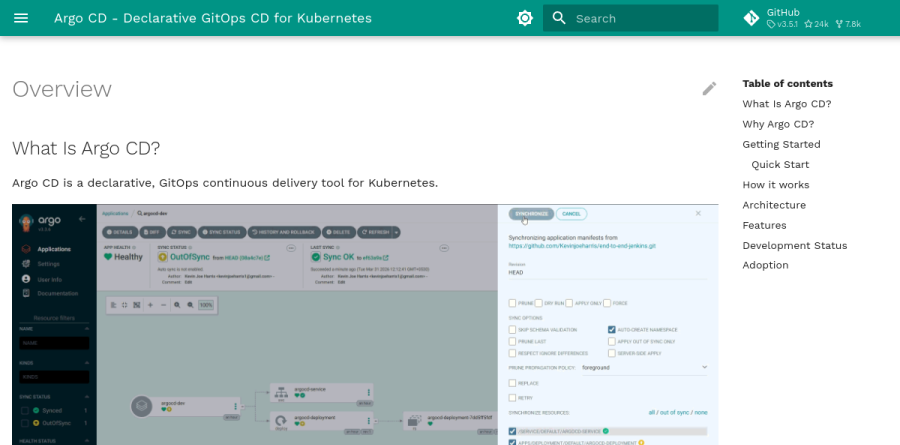
What is Argo CD?
Argo CD is a declarative GitOps continuous delivery tool for Kubernetes, installed as a controller inside the cluster it manages. Rather than pushing releases out of a build pipeline, Argo CD pulls: it watches a Git repository holding your manifests, treats that repository as the target state, and continuously compares it against the live state of the cluster.
The project states its premise plainly, that application definitions, configurations and environments should be declarative and version controlled, and that deployment should be automated, auditable and easy to understand.
How Argo CD detects drift
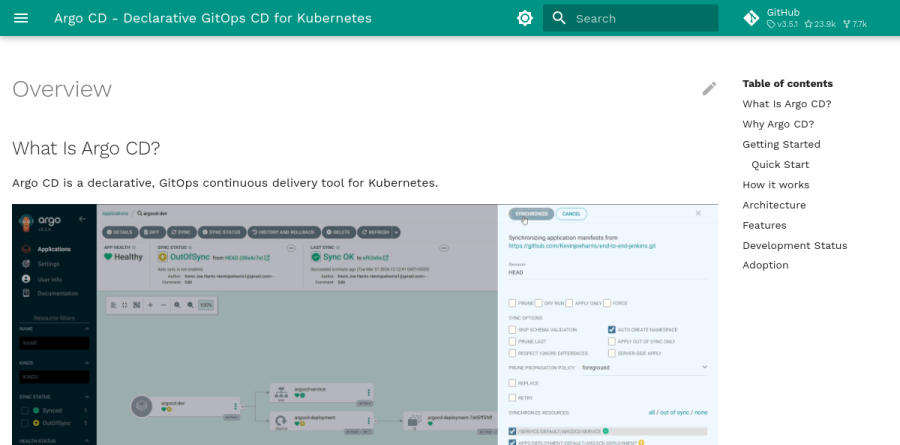
Argo CD models each deployment as an Application, a custom resource definition binding a Git path to a destination cluster and namespace. A refresh compares the latest commit against what is actually running and yields a sync status of Synced or OutOfSync; a sync operation then moves the cluster toward target state. Health analysis runs alongside, so a manifest that applied cleanly but never became ready still shows as unhealthy.
Three components divide the work: an API Server serving the Web UI, CLI and CI systems while handling authentication and Git webhook events, a Repository Server caching repositories and generating manifests, and an Application Controller watching live workloads for drift.
A large part of the appeal is that Argo CD does not impose a templating language. Application source types cover Kustomize, Helm, Jsonnet and plain YAML directories, with Helm parameter overrides per application and configuration management plugins for teams running their own tooling.
Fleet scale falls to the ApplicationSet controller, which expands a single manifest into many Applications. Its List, Cluster, Git and Matrix generators let one definition target every registered cluster or fan out across a monorepo, which is where hand-maintained Application resources usually break down.
Automated sync, self-heal and safe pruning
Sync can stay manual, or an automated sync policy can reconcile the cluster whenever the manifests in Git change; the documented benefit is that CI/CD pipelines no longer need direct access to the Argo CD API server to perform the deployment. Self-heal reverts changes made against the cluster by hand, retrying on a short timeout, and prune removes resources deleted from Git.
Both defaults are deliberately conservative. Pruning stays off until you enable it, and automated pruning will not leave an application with zero resources unless you explicitly override that protection with allowEmpty. The documentation is candid that rollback is unavailable while automated sync is on, which is worth knowing before enabling it everywhere.
For platform teams, Projects make shared installations workable. An AppProject restricts which Git repositories are trusted, which destination clusters and namespaces may receive deployments and which resource kinds are allowed, then defines project roles bound to OIDC groups or JWT tokens.
That pairs with single sign-on across OIDC, OAuth2, LDAP and SAML 2.0, multi-tenancy RBAC policies, audit trails, Prometheus metrics and a Notifications subsystem for routing sync events onward.
Running Argo CD yourself
Installation begins with a kubectl quick start, and the documentation splits cleanly into an Operator Manual for whoever runs the service, a User Guide for whoever ships applications, and separate Extensions, Security Considerations and Roadmap sections. The documentation covers self-managed installation only and quotes no pricing. Teams preferring not to operate the control plane can buy a managed equivalent instead, such as the Pro or Enterprise plans Akuity builds on top of it.
Who should choose Argo CD
Argo CD is the sensible default for teams standardised on Kubernetes that want deployments reviewable in Git rather than buried in pipeline logs. It suits platform engineers running many clusters, regulated environments needing an audit trail, and organisations already invested in Helm or Kustomize.
It is a weaker fit for anyone not running Kubernetes, and for small teams wanting a managed deploy button with no infrastructure to look after: Argo CD is a component you run, upgrade and secure yourself.
Strengths
- Completely free and open source (Apache 2.0) - no per-seat, per-cluster, or per-app fees
- CNCF Graduated project since Dec 2022 with a massive community (~23.6k GitHub stars; used in ~60% of K8s clusters)
- Declarative GitOps with automated sync, self-healing, drift detection, and a rich web UI
- Multiple commercial managed/support paths (Akuity, Codefresh, Red Hat) if you don't want to self-host
Watch out for
- No official paid support from the project itself - you self-manage or pay a third party
- Operational overhead: you run, upgrade, and secure it (self-managed infra roughly $50-150/mo in K8s resources)
- Learning curve for RBAC, ApplicationSets, and multi-cluster/multi-tenant setup
- Advanced ops like AI advisors and environment promotion (Kargo) sit behind paid platforms
Key features
| Feature | What it does |
|---|
| GitOps sync engine | Continuously reconciles live cluster state to the desired state declared in Git. |
| Self-healing & drift detection | Detects config drift from Git and can automatically correct it back to desired state. |
| Web UI, CLI & API | Visual app topology, sync/health status, plus the argocd CLI and REST/gRPC API. |
| Multi-cluster management | Deploy and manage apps across many clusters and namespaces from one control plane. |
| ApplicationSets | Templated generation of applications across clusters and environments. |
| SSO, RBAC & config tooling | OIDC/SAML SSO, fine-grained RBAC, and native Helm, Kustomize, and Jsonnet support. |
How Argo CD compares
| Alternative | How it differs |
|---|
| Flux CD | Other CNCF Graduated GitOps tool, also free; lighter and controller-first with no built-in UI. |
| Spinnaker | Heavier multi-cloud CD platform; more complex to operate and not GitOps-native. |
| Harness / Codefresh | Commercial CD platforms; paid, but add managed support, pipelines, and enterprise features. |
Frequently asked questions
Is Argo CD free?
Yes. Argo CD is 100% free and open source under the Apache 2.0 license. There are no license fees, no per-seat charges, and no limits on clusters, applications, or users. You only pay for the underlying Kubernetes infrastructure it runs on, plus optional third-party managed hosting or support if you choose not to self-host.
How much does Argo CD cost?
The software costs $0. Running it self-managed adds roughly $50-150/month in Kubernetes resources plus engineering time. If you want a managed service, Akuity's Pro plan starts at $495/month and Codefresh's GitOps offering starts around $4,170/year for 5 clusters and 200 apps. Red Hat bundles it free with OpenShift.
Argo CD vs Flux: which is better?
Both are CNCF Graduated GitOps tools and both are free. Argo CD ships a polished web UI, strong RBAC/SSO, and multi-tenant features, making it popular for larger platform teams. Flux is lighter, more Kubernetes-native, and controller-driven with no default UI. Many teams pick Argo CD for visibility; Flux for a minimal, composable footprint.
Is Argo CD really CNCF graduated?
Yes. The Argo project, including Argo CD, reached CNCF Graduated maturity on December 6, 2022, after joining as an incubating project in 2020. A 2025 CNCF survey found Argo CD is the majority-adopted GitOps solution, running in a large share of production Kubernetes clusters at companies like Adobe, Capital One, and Tesla.
Do I need to pay for Argo CD support?
Not necessarily. Community support is free via GitHub, Slack, and docs. For guaranteed SLAs, upgrades, and security notifications, you can buy commercial backing: Akuity from $495/month, Codefresh/Octopus Deploy, or Red Hat OpenShift GitOps included with an OpenShift subscription. Self-managing with community support is fully viable for many teams.
Argo CD ratings on other platforms
Independent user ratings from third-party review sites, linked here for transparency.
These are not our editorial score, are captured on the date shown, and may have changed since.