The full review
What is Airtable AI?
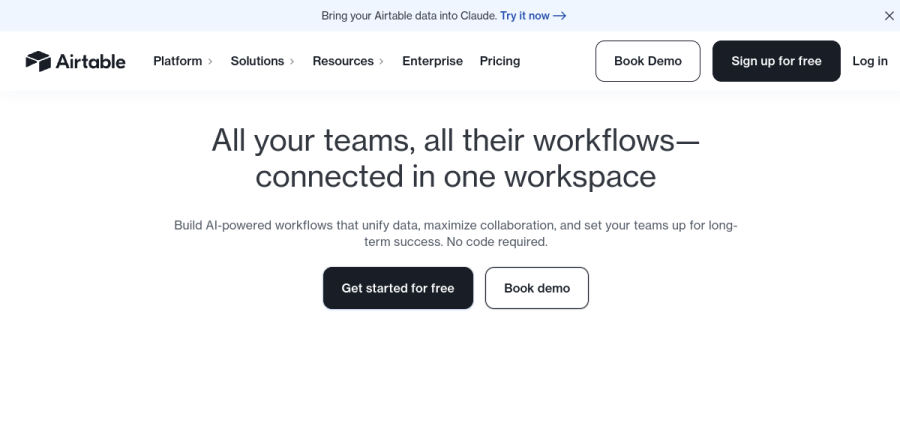
Airtable AI is the layer of agents, assistants, and generative features Airtable has built on top of its mature relational database platform. It is not a standalone chatbot bolted to the side; Airtable describes an AI-native platform that turns your data into dynamic interfaces, automations, and intelligent agents, with Omni taking attachments such as briefs, meeting notes, and docs as context and helping structure that information inside Airtable. Airtable frames the positioning on its homepage as all your teams and all their workflows connected in one workspace, built on AI-powered workflows that unify data and maximize collaboration with no code required.
In practice, Airtable AI surfaces in three places. Omni is the conversational app builder, field agents perform workflow tasks at scale and are meant to be embedded into every business process, and Automations connects the surrounding systems with no code required. All of it inherits the permissions and governance model of the surrounding workspace.
Omni and no-code app building

Omni is described by Airtable as the expert app builder for every business. You explain a workflow in plain language and Omni generates the underlying tables, interfaces, and automations, then leaves every piece editable in the normal Airtable editors, so a generated app becomes a starting point rather than a black box. Omni also accepts attachments, so a campaign brief, meeting notes, or a process document can give it enough context to model your real schema. The vendor highlights data analysis and web research running inside that same conversation.
What field agents handle

Field agents are Airtable's term for AI-powered researchers, analysts, and content creators that perform workflow tasks at scale and can be embedded into every business process. The examples Airtable documents are recognizably operational: enriching inbound leads with real-time company data, drafting campaign-ready content, and triaging feedback through sentiment detection with automatic routing. That last pattern is where the approach earns its keep, since an ops team can point an agent at a research or support backlog and get classification on every row without hand-writing rules. Airtable's own framing is that its agents think dynamically across thousands of records and orchestrate actions across an entire operation.
Automations, interfaces, and the data underneath
AI features are only as strong as the platform beneath them, and that platform is Airtable's genuine advantage. Automations covers everything from a single notification to a multi-sequence workflow built through trigger and action logic, integrates with tools like Google Workspace, Slack, Facebook, and Twitter, and lets you extend that logic with JavaScript when the no-code actions are not enough. Interface Designer is included on every plan from Free upward, letting teams build intuitive interfaces on the same records using Airtable's no-code components. Standard and premium sync integrations, two-way sync, and verified data keep records aligned with source systems, and Airtable states the platform handles datasets in the hundred-million-record range.
Governance and model control
Admin control matters once agents run unattended, and Airtable places those levers on the paid tiers. The Business plan adds an admin panel, SAML-based single sign-on, App Sandbox, and AI Admin controls, while Enterprise Scale layers on Enterprise Hub, HyperDB, App Library, the Enterprise API, plus audit logs and DLP. On model choice, Airtable says enterprise customers can select among providers including OpenAI, Anthropic, and Meta, or deploy via Amazon Bedrock, and states that model providers neither retain the data nor train on it.
Who should choose Airtable AI
Airtable AI fits operations, marketing, and program teams already living in spreadsheets and half-finished trackers, who want agents applied to structured records rather than a general chat window. If your group runs recurring workflows such as campaign production, vendor intake, research pipelines, or feedback triage, Omni and field agents meaningfully shorten the distance between an idea and a working internal app. Note that AI credit allowances scale with the plan, so heavy agent usage pushes you up the tiers faster than seat count alone suggests. It is a weaker fit for engineering teams needing version control and custom backends, or for solo users who simply want a writing assistant.
Strengths
- Omni and Cobuilder turn plain-English prompts into working bases, interfaces, and agents — fast to prototype
- Building apps and agents with Omni is free and does not consume AI credits
- AI is deeply integrated with a mature database, so agents act directly on structured operational data
- Every plan now includes pooled monthly AI credits — the old separate $6/seat AI add-on was retired in mid-2025
Watch out for
- Credit-based AI billing is hard to forecast and gets costly at scale; credits expire monthly with no rollover
- Per-editor seat pricing means even occasional editors count as paid seats
- AI output quality depends heavily on how cleanly your base is structured
- Database-first, not a dedicated automation engine — fewer native third-party integrations than Zapier or Make
Key features
| Feature | What it does |
|---|
| Omni AI agent | Conversational agent that builds apps, automations, and multi-step agents from natural language and can take actions on your data. |
| Cobuilder | Natural-language app generator — describe a workflow and get a base, views, and an Interface; Airtable's fastest-adopted feature. |
| AI Fields & Assistant | Summarize, categorize, translate, extract, and generate content across records at scale, consuming pooled AI credits. |
| AI admin controls | Governance over AI usage, credit pooling, and permissions — restricted to Business and Enterprise plans. |
How Airtable AI compares
| Alternative | How it differs |
|---|
| Zapier | Broader app-to-app automation with AI agents and thousands of integrations, but no built-in database of its own. |
| Make | Visual, usage-based automation with AI modules; cheaper for high-volume workflows but weaker as a data platform. |
| n8n | Open-source, self-hostable AI workflow and agent builder; more flexible for developers but requires more setup. |
Frequently asked questions
Is Airtable AI a separate purchase or add-on?
No. Airtable retired the old $6/seat AI add-on on June 24, 2025. AI credits are now pooled and included in every plan, from Free through Enterprise, with optional credit packs if you need more.
Does building agents with Omni use up my AI credits?
No. Building apps and agents with Omni is free. Credits are only consumed when AI features actually run — AI Fields, the Assistant, and agent executions — not while you build.
Airtable AI ratings on other platforms
Independent user ratings from third-party review sites, linked here for transparency.
These are not our editorial score, are captured on the date shown, and may have changed since.