The full review
What is You.com?
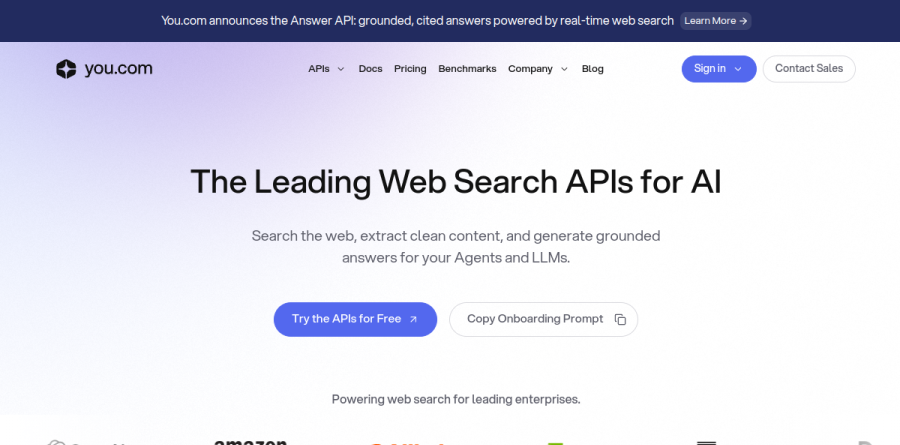
You.com sells web intelligence as infrastructure. The homepage positions the company around web search APIs for AI, promising that developers can search the web, extract clean content, and generate grounded answers for their agents and language models. Rather than one monolithic endpoint, You.com splits the work across five named products: the Web Search API, the Contents API, the Answer API, the Research API, and the Finance Research API.
Everything targets machine consumption. Responses arrive as structured JSON with LLM-ready text, inline citations map back to a sources array, and access runs through API keys, a hosted MCP server, or published Agent Skills. The enterprise pitch leans on SOC 2 certification, zero data retention, DPA readiness, and custom QPS limits.
Search and page extraction
The Web Search API is the foundation. One call returns unified web and news results as structured JSON, each carrying a URL, title, description, and metadata such as publication dates and favicons. The documentation describes automatic news classification, where query intent decides whether news belongs in the response. Text depth is a parameter: snippets by default, highlights for passages that address the question, or full page extraction in Markdown or HTML.
Control lives in the same request. You can raise count toward 100 results, target a country, filter freshness by day, week, month, year, or a custom range, tune safesearch, and shape the index with include_domains, exclude_domains, and boost_domains. When you already have the URLs, the Contents API takes them in a batch and returns clean Markdown or raw HTML.
Cited answers and deep research
The Answer API synthesizes a single response from retrieved passages, returning numbered inline citations plus the exact excerpts behind each claim, and the docs state that every citation is verified against the source text before the response goes out. You.com reports 93.48% accuracy on the SimpleQA benchmark, with typical p50 latency of 2.67 seconds.
The Research API is heavier, running multiple searches, cross-referencing sources, and synthesizing a Markdown answer with inline references. Depth is chosen through the research_effort parameter across Lite, Standard, Deep, Exhaustive, and Frontier, with latency budgets rising at each step. Long jobs run asynchronously in background mode, source_control applies the same domain and freshness filters, and output_schema forces results into a JSON shape your code can consume directly.
Finance research on a dedicated index
Finance Research is the specialist. Instead of the open web it queries a finance-tuned index spanning SEC filings, earnings transcripts, analyst reports, company fundamentals, private market data, equity and commodity prices across dozens of exchanges, and macro indicators such as employment and inflation. Deep and Exhaustive efforts return the same cited, source-reconciled output, which matters when an analyst has to defend a figure. The tradeoff is scope: domain filtering and structured JSON output are not offered here.
Distribution is a genuine strength. A hosted MCP server exposes the tools to Claude Code, Cursor, Codex CLI, VS Code, JetBrains IDEs, and Zed, while a free MCP profile allows 100 queries a day with no signup. Agent Skills named you-web, you-free, you-research, you-finance, and you-discover install with one command and route each request to the right tool. Beyond that sit Python and TypeScript SDKs plus documented integrations with LangChain, LangGraph, LlamaIndex, crewAI, n8n, Zapier, and the Vercel AI SDK.
Who should choose You.com
Choose You.com if you are building an agent or application that needs live web grounding with citations a reader can check, and you want to select depth per query instead of accepting one fixed pipeline. The layered lineup rewards teams that will use the whole range: routine Web Search calls for lookups, the Answer API for fast factual grounding, and Research or Finance Research when a question deserves a real report. Compliance-sensitive buyers get the certifications and data handling answers that procurement asks for. It suits non-technical users poorly, since every product reviewed here is an API reached through code, an MCP server, or a CLI-installed skill, and pay-as-you-go credit billing makes budgeting harder for teams that prefer a predictable flat cost.
Strengths
- ARI research agent scans 400+ sources for cited reports and has beaten OpenAI Deep Research in independent head-to-head tests
- LLM-agnostic platform that integrates new models quickly rather than locking you to one provider
- Transparent per-call pricing for core Search ($5/1k) and Contents ($1/1k) APIs, plus $100 free credit to start
- Enterprise-grade posture: zero data retention, SOC 2, DPA-ready, and custom QPS limits
Watch out for
- Consumer subscriptions (You Pro/Max) were effectively discontinued by 2026 — no plan for individuals who just want a chat/answer UI
- Pricing opacity: only entry Research/Finance tiers are published; Standard, Exhaustive and Frontier require contacting sales
- No permanent free tier — just a one-time $100 credit
- Research calls get expensive at scale ($12–$110+/1k) and effort-based tiers make costs hard to predict
Key features
| Feature | What it does |
|---|
| ARI Research Agent | Advanced Research & Insights agent scans 400+ sources to produce cited reports with charts and graphs; now billed per call through the Research API by research effort. |
| Web Search API | Real-time, LLM-ready web and news search with 1–100 results per call and country/language targeting, at $5 per 1,000 calls. |
| Contents API | Clean page extraction to Markdown or raw HTML with batched URLs at $1 per 1,000 pages — the retrieval layer for grounding RAG apps. |
| Finance Research API | Structured research over filings, macro data and markets with unit/period precision and inline citations, priced from $110 per 1,000 calls. |
How You.com compares
| Alternative | How it differs |
|---|
| Perplexity | Stronger consumer-facing answer engine and Deep Research UI with a simple $20/mo Pro plan for individuals — the audience You.com left behind. |
| ChatGPT Deep Research (OpenAI) | Bundled research inside ChatGPT Plus/Pro; ARI has outperformed it in some independent tests, but OpenAI wins on reach and consumer packaging. |
| Exa | Developer-first search and retrieval API targeting the same RAG/agent grounding use case, often cheaper per call and more API-focused. |
Frequently asked questions
Does You.com still offer the $20/mo You Pro consumer plan?
No. By 2026 You.com retired its consumer subscriptions — You Pro ($20/mo), Team ($30/mo) and the later $200/mo Max plan. The old consumer plans page now redirects to usage-based API pricing, so it is effectively a developer and enterprise platform.
Is there a free way to try You.com?
There is no permanent free tier, but new accounts receive $100 in free credit to test the Search, Contents and Research (ARI) APIs before paying per usage.
You.com ratings on other platforms
Independent user ratings from third-party review sites, linked here for transparency.
These are not our editorial score, are captured on the date shown, and may have changed since.