The full review
What is Rancher?
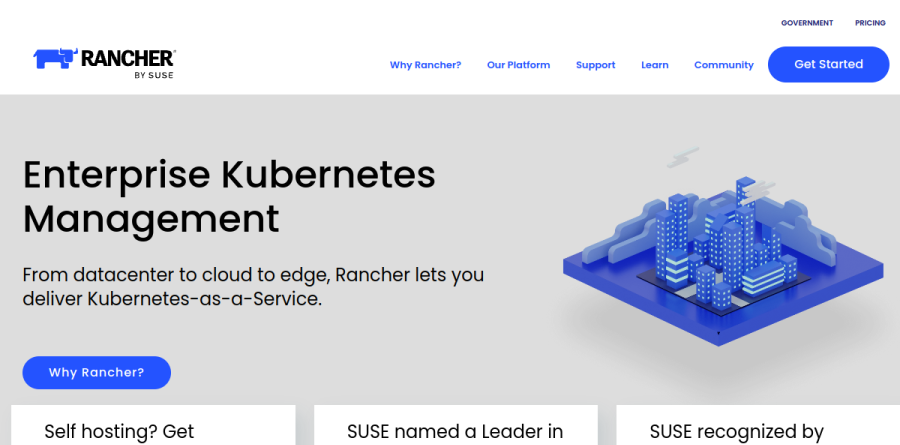
Rancher is an open-source control plane for Kubernetes, built for teams who run more than one cluster and quickly discover that fleets are a management problem of their own. The homepage frames it as enterprise Kubernetes management, taking teams from datacenter to cloud to edge while delivering Kubernetes-as-a-Service internally. In practice that means one interface for provisioning, upgrading, and governing clusters that sit in very different places.
Two identities matter here. The community edition is free and open source, developed alongside sibling projects such as K3s, Longhorn, Kubewarden, and Rancher Desktop. Rancher Prime is the commercially supported distribution from SUSE, adding enterprise support, a curated software supply chain, and extra platform services on the same core.
Cluster operations across every distribution

Rancher imports and provisions clusters rather than imposing one runtime. RKE2 and K3s are the in-house distributions, and Rancher also manages hosted Kubernetes from EKS, AKS, and GKE, so a fleet that grew by acquisition or team preference still lands under one roof. Cluster API and Cluster Classes cover repeatable provisioning, which matters once spinning up a cluster stops being an event and becomes routine.
The quieter win is the Rancher Platform UI Extensions Framework, which lets platform teams surface their own tooling inside the console engineers already use. Instead of building a bespoke portal, you extend the one that ships.
Security, policy, and supply-chain evidence
Security is where Rancher Prime separates itself from a hand-assembled stack. SUSE describes the approach as zero-trust full lifecycle container management, and the pieces are named rather than vague: Kubewarden for policy enforcement, with built-in rules so nobody writes admission logic from scratch, a NeuVector UI integration for runtime protection, and a consolidated security dashboard.
The supply-chain layer earns its own attention. Application Collection and the OCI Prime Registry provide curated container images, and the vendor reports SLSA certification plus SBOM and VEX metadata on what it ships. For teams answering procurement questions about provenance, the draw is that this metadata ships with the artifacts rather than being assembled by hand.
Edge deployments, GPU sharing, and AI-assisted operations
Edge is in scope from the homepage tagline onward — datacenter to cloud to edge — with K3s among the certified projects Rancher develops, and Elemental stretches the same management model down to the operating system. Rancher Prime adds Virtual Cluster GPU multi-tenancy, and NVIDIA MIG GPU sharing sits one tier up in SUSE Rancher Suite, both aimed at the familiar waste of an expensive accelerator reserved by a single team.
The newer layer is operational AI. SUSE describes an agent named Crew, a Rancher Prime AI Assistant, and MCP plug-ins that let assistants query the platform. On the managed side, SUSE Rancher for AWS pairs Amazon EKS lifecycle management with SUSE Observability and an AI-SRE for day 2 work that the vendor says is powered by Amazon Q and Bedrock.
How the editions and support tiers compare
The lineup is clear once the names settle. Rancher is the free community edition. Rancher Prime is the supported enterprise subscription, sold with either Standard or Priority support; SUSE documentation gives Priority round-the-clock handling of the most severe issues plus supportability reviews and upgrade validation checks, while Standard runs on business hours. SUSE Rancher Suite bundles Prime with virtualization, extended Kubernetes support, and the zero-trust security stack. SUSE Rancher for AWS is the self-service SaaS control plane for Amazon EKS, sold through AWS Marketplace and billed per vCPU after a free trial, and it names SSO, RBAC, and LDAP or AD identity management plus Fleet automation for AWS DevOps pipelines.
Who should choose Rancher
Rancher suits platform teams running several clusters across mixed environments — some on-premises, some hosted, perhaps a tail of edge sites — who want one console and one policy model instead of a drawer full of dashboards. It also suits organizations that want to start on the open-source path and add a support contract later, since that move is commercial rather than architectural.
It is a poor fit for a team running a single managed cluster on one cloud; the native console and a few Helm charts handle that with much less to learn. Rancher earns its keep at multiplicity, and adopting it earlier mostly adds another layer to operate.
Strengths
- Core Rancher is genuinely free and fully open source, no node limits
- Single pane to manage clusters across AWS, GCP, Azure, on-prem and edge
- Backed by SUSE with 24x7 enterprise support and a broad add-on portfolio
- New $25/vCPU/mo managed SaaS gives a concrete, low-commitment entry point
Watch out for
- Self-managed Rancher Prime pricing is entirely quote-based, no public list price
- Per-node subscription gets expensive at scale (third-party est. $1,200-$2,800/node/yr)
- Running open-source Rancher yourself requires real Kubernetes expertise
- Add-ons (Longhorn, NeuVector, Harvester) are priced separately, complicating budgets
Key features
| Feature | What it does |
|---|
| Multi-cluster management | Provision, import and centrally operate Kubernetes clusters anywhere from one UI/API. |
| Centralized RBAC & security | Unified authentication, role-based access control and policy across all managed clusters. |
| RKE2 & K3s distributions | Ships SUSE's certified Kubernetes distros for data center and lightweight edge/IoT. |
| Fleet GitOps | Deploy and enforce workloads across thousands of clusters via Git-driven continuous delivery. |
| Prime AI Ops & observability | AI SRE assistant, eBPF observability and faster MTTR in Prime and the managed SaaS. |
| Portfolio add-ons | Optional Longhorn storage, NeuVector runtime security and Harvester HCI under one SUSE One contract. |
How Rancher compares
| Alternative | How it differs |
|---|
| Red Hat OpenShift | More opinionated, fully integrated PaaS; higher list pricing and heavier footprint than Rancher. |
| Portainer | Simpler container/Kubernetes UI with a free tier; less deep multi-cluster enterprise tooling. |
| VMware Tanzu | Enterprise Kubernetes platform; broader vSphere integration but costlier and more complex licensing. |
Frequently asked questions
Is Rancher free?
Yes. The Rancher community edition is completely free and open source, with no node or cluster limits, and you can self-host it at no cost. You only pay when you want Rancher Prime, which adds 24x7 SUSE enterprise support, certified images and AI features, or the $25/vCPU/month managed SaaS on AWS.
How much does Rancher cost?
The open-source version costs $0. Rancher Prime (self-managed) is quote-based per node per year with no public list price; third-party benchmarks estimate roughly $1,200-$2,800/node/year list depending on Standard vs Priority support. The fully managed SUSE Rancher for AWS is officially $25 per vCPU per month with a 30-day free trial.
What is Rancher Prime?
Rancher Prime is SUSE's commercial subscription built on open-source Rancher. It adds 24x7 enterprise support, certified/hardened images, an AI SRE assistant, GPU multi-tenancy via virtual clusters, and access to curated apps. It's sold per node per year (quote-based) and can bundle Longhorn, NeuVector and Harvester under one SUSE One contract.
Rancher vs OpenShift: which is cheaper?
Rancher's open-source core is free, so entry cost is far lower than OpenShift, which requires a paid subscription. For supported production use, both use custom enterprise quotes, but Rancher Prime's per-node model is generally lighter and more flexible. OpenShift bundles more built-in PaaS features, which raises its price and complexity.
Is Rancher Prime pricing published?
No. The rancher.com/pricing page is a request-a-quote form, and the SUSE shop requires login to see per-node prices, so self-managed Prime pricing is not publicly listed. The only concrete published figure is the managed SUSE Rancher for AWS at $25 per vCPU per month. All per-node dollar ranges come from third-party estimates.
Rancher ratings on other platforms
Independent user ratings from third-party review sites, linked here for transparency.
These are not our editorial score, are captured on the date shown, and may have changed since.