The full review

What is Cloudflare Zero Trust?
Cloudflare Zero Trust is the workforce security layer of Cloudflare One, the company's single-vendor SASE platform. It is less a single product than a stack of services run from one dashboard: zero trust network access, secure web gateway, CASB, remote browser isolation, data loss prevention, email security and digital experience monitoring.
What sets it apart is where it runs. Those services run on the same global network that carries Cloudflare's CDN and DNS traffic; the vendor says it delivers full SASE from 335+ cities. Cloudflare also markets post-quantum encryption across the full stack, plus newer controls for AI agents and MCP server connections.
Replacing the VPN with Access and Tunnel
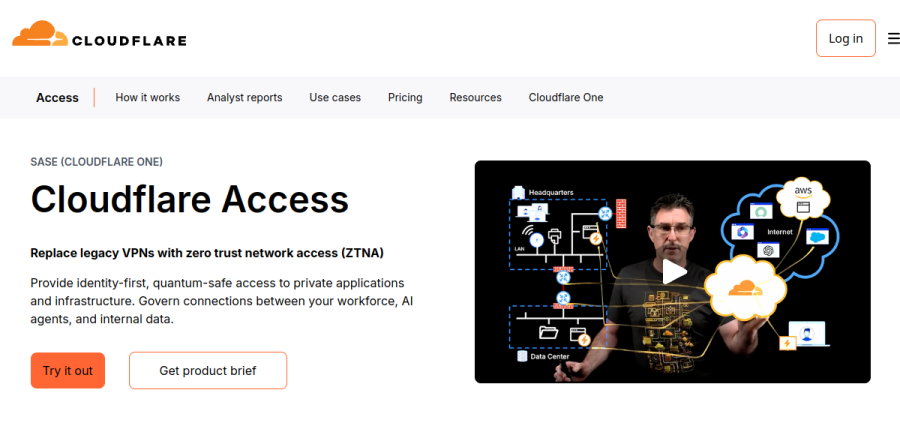
Cloudflare Access is the ZTNA component, pitched squarely as a legacy VPN replacement. Instead of dropping users onto a flat network, Access authenticates each request against an identity provider and evaluates context before opening a single application. Policies key off IdP groups, geolocation, device posture, session duration and external API calls, and multiple identity providers can run concurrently alongside generic SAML and OIDC connectors.
Pairing Access with Cloudflare Tunnel is where teams feel the change. The lightweight cloudflared daemon opens an outbound-only connection, so internal apps need no public IP and no inbound port. Non-web systems are covered too, including SSH, VNC and RDP, with browser-based SSH and VNC for admins. Cloudflare markets clientless options and social identity providers for authenticating third-party users such as contractors.
Filtering traffic with Gateway and Browser Isolation
The Secure Web Gateway governs outbound traffic with a policy model deeper than a typical DNS filter. Gateway supports DNS policies that stop a domain resolving, network policies matching IP, port, protocol and SNI, HTTP policies that decrypt and inspect URLs, headers and file transfers, egress policies pinning traffic to fixed organizational IPs, and resolver policies routing queries to internal nameservers.
Remote Browser Isolation layers on top, running web code at the network edge rather than the endpoint. Conditional isolation with data loss controls lets a risky site open in a contained session instead of being blocked outright, and because it works with or without a device client, unmanaged and third-party devices can safely reach internal tools.
Data and email protection across SaaS
Cloudflare CASB scans connected SaaS tenants for misconfigurations, insider threat signals and unsanctioned application use, while DLP inspects web traffic and SaaS content for sensitive material such as financial identifiers and source code. Email Security adds inbox policies, automated routing and message investigation, and Digital Experience Monitoring surfaces device, network and application telemetry when a user reports that something feels slow. Cloudflare positions the stack as one control plane, data plane and infrastructure layer, centralising visibility and control in one unified dashboard, API and Terraform provider.
Plan structure and what to expect
Cloudflare documents its tiers as Zero Trust Free, Standard and Enterprise, with feature ceilings widening as you move up. Cloudflare invites teams to start a proof of concept on the free plan. One caveat before budgeting: the public SASE pricing page does not publish per-seat figures for Cloudflare One, directing buyers to a packaging conversation instead.
Who should choose Cloudflare Zero Trust
Cloudflare Zero Trust suits organizations retiring a legacy VPN that would rather not assemble four separate vendors, and it fits especially well when DNS or CDN services already run on Cloudflare, since the network, dashboard and billing relationship are in place. Small teams can start on the free plan, though Cloudflare's public pages do not enumerate which capabilities that tier includes.
It is a weaker fit for buyers who need transparent self-serve pricing above the free tier, or for security teams committed to on-premises appliances they physically control, since packaging runs through sales and the architecture assumes traffic traverses Cloudflare's edge. Organizations with strict data residency rules should review that model closely before committing.
Strengths
- Free plan covers up to 50 users — the most generous ZTNA free tier on the market
- Competitive $7/user/month with no seat minimum on the paid tier
- Full SASE stack (ZTNA, SWG, CASB, DLP, DNS) on Cloudflare's fast global network
- Clientless and WARP-agent access with strong IdP and device-posture integrations
Watch out for
- Paid Pay-as-you-go plan is billed annually only — no monthly option
- Remote Browser Isolation, custom DLP and email security are gated to custom Enterprise contracts
- Free tier caps log retention at 24 hours and network locations at three
- Broad platform has a steeper learning curve than single-purpose tools like Twingate
Key features
| Feature | What it does |
|---|
| Access (ZTNA) | Identity-based, per-application access that replaces VPNs with least-privilege policies. |
| Gateway (SWG) | Secure Web Gateway with DNS, HTTP and network filtering plus threat inspection. |
| CASB | Scans SaaS apps for misconfigurations and data exposure; expanded on Enterprise. |
| DLP | Data Loss Prevention with predefined policies on paid tiers, custom rules on Enterprise. |
| Browser Isolation | Remote Browser Isolation runs risky web sessions in the cloud; Enterprise/add-on. |
| WARP device agent | Endpoint client for Windows, macOS, Linux, iOS and Android enforcing device posture. |
How Cloudflare Zero Trust compares
| Alternative | How it differs |
|---|
| Twingate | Simpler, developer-friendly ZTNA; free tier caps at 5 users, Team plan ~$6/user/mo. |
| Zscaler Private Access | Enterprise SSE/ZTNA leader; custom, sales-led pricing that is typically pricier. |
| Tailscale | WireGuard mesh VPN; free for 3 users, paid from ~$6/user/mo, lighter on SWG/DLP. |
Frequently asked questions
How much is Cloudflare Zero Trust?
Cloudflare Zero Trust is free for up to 50 users with full ZTNA, Secure Web Gateway and DNS filtering. Beyond 50 seats, the Pay-as-you-go plan costs $7 per user per month, billed annually, with no user cap and 30-day log retention. Enterprise pricing is custom and adds CASB, custom DLP and Remote Browser Isolation.
Is Cloudflare Zero Trust really free?
Yes. The Free plan is permanent, not a trial, and covers up to 50 users at $0. It includes ZTNA (Access), Secure Web Gateway, DNS filtering and basic device posture, but caps log retention at 24 hours and limits you to community support and three network locations. Exceed 50 users and every seat moves to the $7 tier.
Is Cloudflare Zero Trust a VPN or ZTNA?
It is a ZTNA platform built to replace legacy VPNs, not a traditional VPN. Cloudflare Access grants per-application, identity-based access with no network-wide tunnel, while the WARP agent secures device traffic. It is one pillar of Cloudflare One, Cloudflare's single-vendor SASE platform, alongside the Secure Web Gateway, CASB and DLP services.
Cloudflare Zero Trust vs Twingate: which is better?
Both are ZTNA tools priced around $5-7 per user monthly. Cloudflare bundles ZTNA, SWG, DNS filtering, CASB and DLP into a full SASE suite on its global network and is free up to 50 users. Twingate is simpler and faster to deploy, but its free tier caps at 5 users. Pick Cloudflare for breadth, Twingate for quick VPN replacement.
What is included in Cloudflare Zero Trust?
Every plan includes ZTNA (Access), the Secure Web Gateway (Gateway), DNS filtering and device posture. Paid tiers add predefined DLP and 30-day logs. Enterprise unlocks expanded CASB, custom DLP, Remote Browser Isolation, email security, dedicated egress IPs and six-month retention. Remote Browser Isolation is third-party reported near $10 per user monthly as an add-on.
Cloudflare Zero Trust ratings on other platforms
Independent user ratings from third-party review sites, linked here for transparency.
These are not our editorial score, are captured on the date shown, and may have changed since.