The full review
What is Babbel?
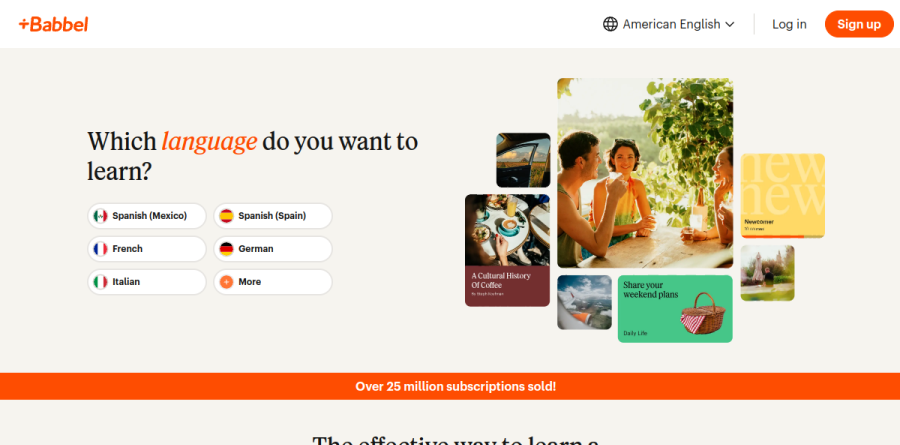
Babbel is a subscription language-learning app built around short, tightly structured lessons rather than open-ended practice. The homepage pitches it as "the effective way to learn a language online," and the catalog covers Spanish for both Mexico and Spain, French, German, Italian, Portuguese, Russian, Dutch, Danish, Norwegian, Swedish, Polish, Turkish, and Indonesian.
What separates Babbel from the gamified crowd is how openly it teaches. Dialogues are modeled on situations you would actually land in, grammar is explained rather than absorbed by osmosis, and the vendor stresses that its recordings come from native speakers instead of synthetic voices. Courses run from Newcomer A1 upward along an A1 to C1 progression, with a free assessment quiz that places you before you start.
The Babbel Method behind the lessons

Babbel gives its pedagogy a name, and the Babbel Method page makes the reasoning unusually explicit. The vendor says the approach was empirically proven by academics from Yale University, City University of New York, and Michigan State University, and claims the method gets you speaking in as little as three weeks, on ten minutes a day.
The mechanic doing most of the work is spaced repetition. Babbel resurfaces vocabulary just before you are likely to forget it, and the vendor describes this as moving words through six memory stages into long-term retention. In practice that means every session blends fresh material with quiet review, so progress compounds instead of evaporating between sittings.
Speaking practice without booking a tutor
Pronunciation is where most self-study apps quietly give up, and Babbel leans on speech recognition to grade how you sound rather than only what you tap. Real-time feedback and progress trackers sit alongside it, giving you a visible sense of which sounds are still slipping.
The newer piece is Babbel Speak, a beta feature that puts you in conversation with an AI partner. Babbel positions it as practice for real exchanges rather than isolated sound drills, which is the more useful framing. Babbel lists it alongside language exchanges as a way to practice speaking for the real world.
Learning that continues outside the app

Much of the Babbel value sits around the lessons rather than inside them. Babbel Podcasts sit alongside the lessons for extra listening, video lessons cover topics like learning the language before a vacation and speaking like a local, and Babbel Magazine collects stories from around the world, language-learning tips and culture pieces.
Toucan is the cleverest of these extras, a free browser extension that helps you pick up the language while you read and browse the web. Special courses on culture, travel, and business round out the catalog for learners with a specific destination or job in mind.
Fitting Babbel into a real week
Lessons average around fifteen minutes in the app and are downloadable, which makes Babbel genuinely usable on a commute or a flight without signal. That bite-size format is why the daily-habit framing holds up better here than in tools expecting a long uninterrupted sitting.
Babbel also sells gift subscriptions through its separate gift shop, and a free Babbel lesson lets you test the teaching style before committing anything. Travelers with a trip already on the calendar, professionals preparing for a relocation, and anyone reconnecting with a family language all get a clear runway from the placement quiz onward.
Who should choose Babbel
Babbel suits adults who want structure and explanation, people who find pure gamification hollow and would rather understand why a sentence works the way it does. If you are heading somewhere specific, studying a European language, and can commit ten focused minutes most days, this is close to an ideal fit.
It is less ideal if your target language sits outside the catalog. The lineup I reviewed is European-heavy, with no Mandarin, Japanese, Korean, or Arabic on offer. Learners who want an entirely free path, or who need live correction from a human teacher, will find Babbel meets only part of that need.
Strengths
- Dialogues and grammar explanations grounded in practical, real-world conversation
- Courses designed by linguists with clear didactic progression, not just gamification
- Genuinely good value on 12-month and lifetime plans, with frequent 50%+ promotions
- Speech recognition and a spaced-repetition Review Manager reinforce retention
Watch out for
- A standard subscription unlocks only one language; multi-language needs the pricier Complete or Lifetime plan
- Just 14 languages, heavily skewed to European ones; Asian-language depth is thin or absent
- Content tapers off past intermediate (B1/B2) and isn't suited to advanced learners
- Babbel Live consumer tutoring classes were discontinued in July 2025, leaving no live-human option for individuals
Key features
| Feature | What it does |
|---|
| Bite-sized structured lessons | 10–15 minute lessons built by linguists around practical dialogues and everyday scenarios. |
| Speech recognition | Pronunciation practice with voice feedback to build speaking confidence. |
| Spaced-repetition review | Review Manager resurfaces vocabulary over time to move it into long-term memory. |
| Podcasts and Stories | Supplementary listening and reading content graded by proficiency level for immersion practice. |
How Babbel compares
| Alternative | How it differs |
|---|
| Duolingo | Free, gamified, and broader language range, but far shallower on grammar and real conversation. |
| Busuu | Similar structured courses plus a native-speaker feedback community; comparable pricing. |
| Rosetta Stone | Immersion-based method with its own lifetime deal; weaker on explicit grammar explanation. |
Frequently asked questions
Is Babbel free?
Not fully. The first lesson of every course is free, but the rest of the curriculum, speaking exercises and review tools require a paid subscription.
Does one subscription cover all 14 languages?
No. A standard subscription covers a single language. To access all languages you need the Babbel Complete subscription or the one-time Lifetime purchase.
Babbel ratings on other platforms
Independent user ratings from third-party review sites, linked here for transparency.
These are not our editorial score, are captured on the date shown, and may have changed since.