The full review
What is Writesonic?
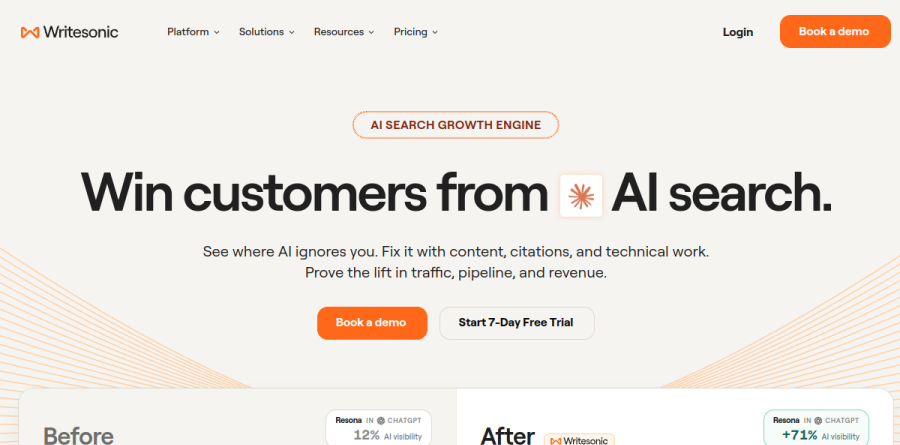
Writesonic sells itself as an AI search growth engine. The homepage states the job plainly: see where AI ignores you, fix it with content, citations and technical work, then prove the lift in traffic, pipeline and revenue. In practice Writesonic watches how ChatGPT, Gemini, Google AI Overviews and other assistants describe a brand, then supplies the machinery to change those answers.
The distinction it draws is between reporting and doing. The vendor calls its model the AI Search Loop, a cycle of track, prioritize, act and prove, and states that most AI search tools show you the gap and stop, while Writesonic runs the fix and proves the lift.
Inside the AI Visibility Tracker
The AI Visibility Tracker is the measurement layer. Writesonic reports that it crawls the actual web interface of ChatGPT, Claude, Gemini, Google AI and six further platforms the way a buyer would, rather than querying models through APIs, because API responses diverge from what people really see. Daily runs record how often a brand surfaces, which pages and domains get cited, what sentiment attaches to each mention, and how share of voice compares against named competitors, with filters for competitor, market, language and intent.
Related capabilities named alongside it include Brand Explorer, AI Search Volume, Query Fanouts, Prompt Volume, Ads Tracking and Shopping Tracking.
The Action Center does the fixing

Here Writesonic presses its case hardest. Every opportunity in the Action Center arrives scored by ICE, meaning impact, confidence and effort, so a team can begin with high impact and low effort. On-page work covers what the vendor counts as fifteen or more GEO levers, among them page structure, FAQs, freshness, comparison tables and self-contained passages, with one click pushing revisions to the CMS.
Off-page work surfaces domains citing competitors ranked by domain rating, drafts outreach inside the platform, and flags Reddit threads and Wikipedia entries worth a contribution. Technical work inspects robots.txt for blocked crawlers such as GPTBot, ClaudeBot and PerplexityBot, and catches 404s and 500s served only to AI bots, which server-side tracking picks up.
Content production under the hood
Writesonic never walked away from writing. AI Article Writer runs an automated pipeline the vendor describes as ten phases and more than a hundred steps per piece, with a Chief Editor pass, a Humanizer and Gate stage for stripping AI tells, EEAT signals, author and reviewer schema, sitemap-aware internal linking, and one-click export to WordPress, Sanity, Contentful, Webflow and Ghost. A Content Agent and a monthly site audit allowance round out the SEO half, so a team can measure, brief, draft and publish without leaving Writesonic.
How the plans differ
Starter tracks ChatGPT, Gemini and Google AI Overviews for one user on one project, with prompts and answers checked daily plus monthly allowances for AI articles and site audits. Basic widens prompt and answer volume, lifts the article allowance and deepens audit page limits for two users. Growth includes Sentiment Analysis outright, unlocks an Action Center trial covering a few off-page and on-page actions monthly, and adds priority support across three users and two projects. Enterprise opens all ten tracked platforms, the full Action Center, custom regions and languages, Looker Studio integration, a dedicated AI search strategist, and compliance covering SSO or SAML, SOC 2 Type II, HIPAA and GDPR.
Who should choose Writesonic
Writesonic fits marketing teams that already treat AI search as a real channel and want one platform to measure it and act on it, rather than a dashboard plus a separate content stack. Agencies running GEO retainers get client reporting and execution in the same place, while ecommerce and PR teams get the shopping and reputation angles specifically. It is a poor fit for anyone who simply wants a cheap assistant for the occasional blog draft, since entry pricing reflects a full visibility platform rather than a writing tool. Sentiment Analysis, the Action Center and unrestricted agentic workflows also sit on the upper tiers, so buyers who want the complete loop should plan around Growth or Enterprise.
Strengths
- Action Center closes the loop — it flags citation gaps and suggests concrete on-page and outreach fixes, not just a visibility score
- Cloudflare-based AI bot tracking shows which engines crawl your site and which pages, a data point most GEO rivals lack
- Broad platform and market coverage (ChatGPT, Gemini, Google AI Overviews, up to ~10 engines, 50+ markets)
- Bundles GEO tracking, site audits and AI article generation, reducing tool sprawl for content-led teams
Watch out for
- Expensive for monitoring-only needs — meaningful AI-visibility tracking effectively starts around $199-$399/mo
- Identity is split between legacy AI writing and new GEO focus, so parts of the product feel like a work in progress
- Agentic workflows and full Action Center are trial-limited until Enterprise, gating the most-hyped features
- Low tiers cap prompts, projects and seats tightly, forcing quick upgrades as usage grows
Key features
| Feature | What it does |
|---|
| AI search visibility tracking | Monitors how often and how your brand is mentioned across ChatGPT, Gemini and Google AI Overviews, with share-of-answer and sentiment on higher tiers. |
| Action Center | Turns visibility gaps into a task list — on-page recommendations plus third-party outreach with author contacts, then tracks impact on citations. |
| AI bot & crawler tracking | Cloudflare-based view of which AI engines crawl your site and which URLs they hit, informing technical GEO decisions. |
| Content engine & site audits | Generates AI articles and runs multi-hundred-to-thousand-page site audits, tying content production to the visibility data. |
How Writesonic compares
| Alternative | How it differs |
|---|
| Profound | GEO-native brand answer-tracking across LLMs; monitoring-first and enterprise-priced, without Writesonic's built-in content engine. |
| Otterly.AI | Lower-cost AI search-visibility monitoring for ChatGPT, Perplexity and AI Overviews; simpler and cheaper but lighter on action tooling. |
| Peec AI | European GEO analytics tool focused on AI mention tracking and competitor benchmarking; leaner scope than Writesonic's all-in-one bundle. |
Frequently asked questions
Is Writesonic still an AI writing tool or an SEO tool now?
Both, but the emphasis has shifted. It began as an AI copywriter and has repositioned as an AI Search Visibility (GEO) platform. It still produces AI articles, but the headline features now track and improve how AI engines cite your brand.
Is there a free version, and how far does it go?
Yes. A free plan needs no card and gives roughly one AI article, a few AI-agent generations and one 100-page site audit per month — fine for evaluating the tool, but serious visibility tracking requires the $79+/mo paid tiers.
Writesonic ratings on other platforms
Independent user ratings from third-party review sites, linked here for transparency.
These are not our editorial score, are captured on the date shown, and may have changed since.