The full review
What is Udacity?
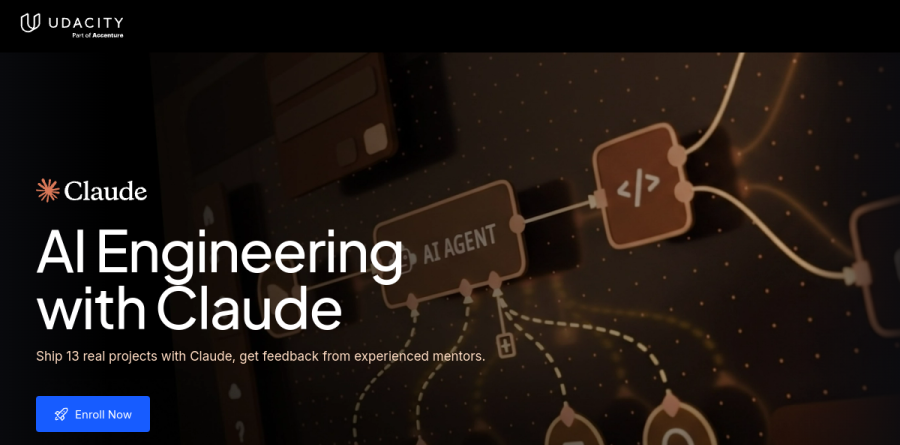
Udacity is an online technology school built around Nanodegree programs, multi-course tracks in AI, data, cloud, programming, cybersecurity, product management and business analytics. The company is now part of Accenture, a relationship carried in the site's header logo. The homepage pitch is Learn. Lead. Transform. The catalog backs it up with tracks like Agentic AI, Generative AI, AI Programming with Python, Data Engineering with AWS and Self Driving Car Engineer.
Rather than selling isolated video lessons, Udacity organizes each Nanodegree into a program outline of courses, lessons and graded projects. The Agentic AI Nanodegree, for example, lists four courses, 67 lessons and four projects across roughly 53 hours. A subscription unlocks the catalog, which the vendor puts at 500-plus courses, and every completed program yields a graduation certificate.
Project work is the real product

The differentiator at Udacity has always been the project rather than the lecture. Program pages spell out what you build: the Agentic AI track ships an AgentsVille Trip Planner multi-agent travel assistant, an AI-powered project manager and an automated sales system. The same track also ships UdaPlay, an AI research agent for the video game industry. The upshot is that you finish with artifacts a hiring manager can actually inspect.
Mentor feedback and career coaching
Every Udacity subscription advertises hands-on projects with expert feedback alongside personalized career coaching and interview prep. Projects are reviewed by working practitioners rather than auto-graded, and Udacity staffs that network through an open Become a Mentor program. For anyone who has stalled halfway through a self-paced course elsewhere, this human review loop is the part worth paying for.
An AI-first catalog that keeps moving
The catalog is organized into twelve schools, including Artificial Intelligence, Data Science, Cloud Computing, Cybersecurity and Product Management. Program pages carry an Updated date, with the Agentic AI Nanodegree showing a mid-2026 refresh, so staleness is easy to check before enrolling.
Udacity for Business

Udacity for Business runs on its own platform features: skill measurement and indexing, organizational analytics that feed into existing learning systems, a guided cohort model, and Technology Quotient, a foundational library for AI, cloud and data fluency across an entire workforce. The vendor reports a 60% lift in graduation outcomes for cohorts versus traditional self-paced learning, plus a 35% productivity increase, all based on research it conducted itself. Enterprise buyers get Demo Skills and Contact Us routes instead of a published price.
Plans and the accredited degree pathway
Individual access arrives as a Monthly Subscription or a four-month Bundle Subscription, and program pages also offer a one-time Individual Course purchase for buyers who want a single Nanodegree without a recurring plan. Udacity now runs graduate options as well, a Master of Science in AI it bills as fully accredited and a Master of Business Administration, letting you earn academic credit while you learn for a one-time $199 enrollment fee on top of the subscription.
Who should choose Udacity
Udacity suits the career switcher or working engineer who needs structure, deadlines and a reviewer willing to tell them their code is not ready yet, and who wants a defensible portfolio in AI, data or cloud at the end. It fits employers funding a measurable upskilling push even better, thanks to the cohort and analytics tooling. It is a weak fit for casual browsers and hobbyists: this is a recurring premium subscription that only pays off at a steady study pace, so anyone dipping in occasionally, or looking for breadth well beyond tech and business, will find better value elsewhere.
Strengths
- Real human project reviews and mentorship, not just auto-graded quizzes
- Job-relevant, frequently refreshed content in AI, data, cloud, and programming
- Single subscription unlocks the entire catalog rather than paying per program
- Hands-on portfolio projects that map to actual employer expectations
Watch out for
- At $249/month it is among the most expensive upskilling platforms available
- List prices are opaque, heavily promo-driven, and only render after login/JS load
- Refund window is a strict 2 days (14 for EU), unusually short for the price
- Narrow focus on tech/business means little for non-technical fields
Key features
| Feature | What it does |
|---|
| Nanodegree programs | Structured, multi-project credentials in AI, data science, programming, cloud, and business |
| Reviewed projects | Portfolio work assessed with personalized written feedback from expert reviewers |
| Mentor and career support | Real-time technical help plus resume, LinkedIn, and interview coaching |
| All-access catalog | One subscription covers 80+ Nanodegrees and 300+ courses with completion certificates |
How Udacity compares
| Alternative | How it differs |
|---|
| Coursera | University- and vendor-backed certificates at a fraction of the price, but far less hands-on project feedback |
| DataCamp | Cheaper, browser-based data/AI upskilling; stronger for pure skill drills, weaker on graded portfolio projects |
| Pluralsight | Deep tech skill library with assessments and paths; more affordable, but no human project reviews or mentorship |
Frequently asked questions
Does Udacity have a free plan?
Yes. Udacity offers roughly 190+ standalone free courses, but the mentorship, reviewed projects, coaching, and certificates require a paid subscription.
Is Udacity still independent?
No. Udacity was acquired by Accenture and now operates as 'Udacity, part of Accenture,' with much of its focus shifting toward enterprise reskilling.
Udacity ratings on other platforms
Independent user ratings from third-party review sites, linked here for transparency.
These are not our editorial score, are captured on the date shown, and may have changed since.