The full review
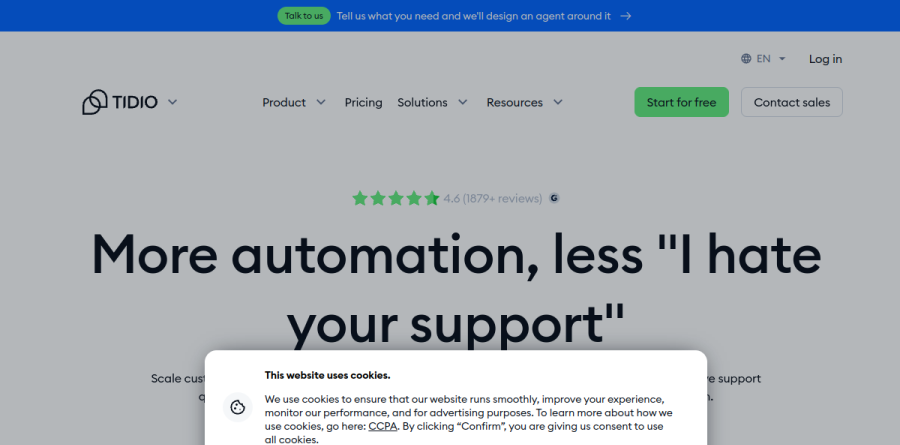
What is Tidio?
Tidio is a customer communication platform that combines live chat, a multichannel help desk, and AI automation behind a single widget. Tidio runs those pieces from one dashboard, so a visitor message, an Instagram DM, and an email all land in the same multichannel inbox, while Lyro builds its own knowledge base by scraping your existing support content.
The vendor markets four connected products: the core Tidio platform, the Lyro AI Agent, Hubi AI for marketing work, and Tidio Labs for custom builds. Tidio reports more than 300,000 businesses on the platform. The entry plans cover live chat and ticketing while metering Lyro AI conversations and Flows visitors separately - Starter includes 50 Lyro conversations and 100 Flows visitors - so the automation layer scales up as volume grows.
Live chat and ticketing in a shared inbox
Tidio Help Desk is the operational core. Conversations from the chat widget, email, Messenger, Instagram, and WhatsApp converge in a multichannel inbox where an agent can turn any thread into a ticket, set ticket priority, lean on automated routing, and fire canned answers through macros. Advanced ticket filtering keeps the queue readable, while higher plans layer on automatic chat assignment, user permissions, and departments for teams that split work by function. Tidio reports an average 24 percent CSAT uplift for brands that switch over, and claims setup takes under ten minutes.
What the Lyro AI Agent actually does

Lyro is the piece Tidio leans on hardest. It answers repetitive questions from your own knowledge base and escalates to a person under handoff rules you set. Lyro Smart Actions push it past replying into performing recurring tasks, Product Recommendations surface catalog items mid-conversation, and Lyro Guidance lets you shape tone and behaviour the way you would coach a new teammate. If you already run another help desk, Lyro Connect attaches the agent to Zendesk, Intercom, or Salesforce instead of replacing them.
Tidio reports an average automated resolution rate of 67 percent and calls it the best available. Treat that as a vendor figure, but note the product ships resolution-rate and satisfaction analytics, so you can measure the claim against your own traffic.
Flows for conversion, not just deflection

Flows is the no-code automation builder, and it aims at revenue as much as at support relief. The drag-and-drop editor ships with more than forty templates spanning cart recovery, cross-selling, scarcity messaging, quote requests, appointment booking, and Instagram Story replies. Every Flow starts with a trigger node, which Tidio describes as an if-X-happens-then-do-Y rule carrying additional rules and parameters. Tidio reports a 26 percent conversion lift from contextual Flows.
Ecommerce fit and integrations
The ecommerce bias shows in what Tidio connects to. Tidio lists a deep Shopify integration alongside Mailchimp, HubSpot, WordPress, Squarespace, Zapier, and 120-plus tools to integrate. For a store owner, the relevant piece is Lyro Smart Actions, which Tidio says automates order updates or lead qualification without human assistance.
How the Tidio plans are structured
Tidio bills by conversation rather than by seat, which suits small teams with spiky demand. Starter covers live chat and ticketing with basic analytics. Growth adds advanced analytics, macros, user permissions, and automatic chat assignment. Plus brings departments, multiproject, custom branding, OpenAPI access, and a dedicated success manager. Premium is the negotiated tier, with pay-per-resolution billing, guaranteed resolution targets, SSO, a mobile SDK, and Lyro delivered as a managed service. Lyro AI Agent and Flows are also sold as standalone add-ons, each with a seven-day trial.
Who should choose Tidio
Tidio suits small and mid-sized ecommerce or service businesses that want live chat, ticketing, and a working AI agent from one vendor without a long rollout. Shopify merchants extract the most from it, and a team simply testing whether AI deflection works can buy Lyro on its own. It is a weaker fit for large enterprises with intricate routing rules, heavy CRM dependencies, or phone-first support, where the ticketing depth will feel thin next to a dedicated enterprise suite and per-conversation pricing gets harder to forecast at scale.
Strengths
- Genuinely useful free plan: 50 conversations/month, 10 seats, live chat, ticketing, and email in one inbox
- Lyro AI is strong for the price — Premium even offers pay-per-resolution billing with a guaranteed 50% resolution rate
- Fast no-code setup with native Shopify, WordPress, Messenger, Instagram, and WhatsApp integrations
- Fair billing definition: only conversations a human agent actually replies to count against your quota
Watch out for
- Advertised prices exclude AI — Lyro costs an extra $32.50–$700+/month, so real-world bills often run 2–3x the sticker price
- Conversation quotas don't roll over month to month; unused capacity is simply forfeited
- All self-serve plans cap at 10 agent seats, and there's a jarring pricing cliff between Growth (~$349 ceiling) and Plus ($749+)
- Removing 'Powered by Tidio' branding costs about $20/month extra unless you're on Plus or higher
Key features
| Feature | What it does |
|---|
| Live chat widget | Customizable chat with real-time visitor list, typing preview, canned responses, and video call support |
| Lyro AI Agent | Conversational AI trained on your help content; answers customer questions automatically, sold from $32.50/mo or bundled on Premium |
| Flows automation | No-code chatbot builder for cart recovery, lead capture, and triggered messages; 100 visitors reached free, standalone from $24.17/mo |
| Multichannel inbox | Email, Messenger, Instagram, and WhatsApp conversations unified in one shared team panel |
| Help desk & ticketing | Convert chats to tickets with macros, offline auto-replies, and ticketing automations on Growth and above |
| Analytics & permissions | Advanced analytics, user permissions, and automatic chat assignment unlock on the Growth tier |
How Tidio compares
| Alternative | How it differs |
|---|
| Intercom | Deeper AI (Fin) and product messaging, but per-seat pricing plus $0.99/resolution makes it pricier for SMBs |
| Zendesk | Enterprise-grade ticketing, SLAs, and reporting for large teams; heavier setup and per-agent pricing |
| Tawk.to | Completely free live chat with unlimited seats, but no equivalent of Lyro AI or Flows automation |
Frequently asked questions
How much does Tidio cost?
Tidio has a free plan with 50 conversations per month. Paid plans start at $29/month (Starter, 100 conversations) or $24.17/month billed annually. Growth runs roughly $59–$349/month for 250–2,000 conversations, Plus starts at $749/month, and Premium is quote-only (reportedly ~$2,999+). Lyro AI is a separate add-on from $32.50/month.
Is Tidio free to use?
Yes. The free plan includes live chat, ticketing, and email management for up to 10 seats and 50 billable conversations per month, plus a one-time 50-conversation Lyro AI allowance and 100 Flows visitors. Every paid plan also comes with a 7-day free trial that requires no credit card.
How much does Tidio's Lyro AI cost?
Lyro AI Agent is billed separately from base plans. Standalone pricing starts at $32.50/month annually (about $39 monthly) for roughly 50–100 AI conversations, scaling past $700/month at high volumes. The Premium plan bundles 3,000+ Lyro conversations monthly with pay-per-resolution billing and a guaranteed 50% resolution rate.
Tidio vs Zendesk: which is better?
Tidio wins for small teams: free plan, paid from $29/month, and setup in minutes with Lyro AI from $32.50/month. Zendesk runs about $19–$55+ per agent/month and suits larger support organizations needing deep ticketing, SLAs, and multi-team workflows. Pick Tidio for SMB ecommerce chat; pick Zendesk for enterprise help desks.
What counts as a billable conversation in Tidio?
A conversation only becomes billable when a human agent replies — visitor messages your team never answers don't count. Free includes 50/month, Starter 100, and Growth 250–2,000 depending on the tier you select. Quotas reset monthly and unused conversations don't roll over, so size your plan to actual reply volume.
Tidio ratings on other platforms
Independent user ratings from third-party review sites, linked here for transparency.
These are not our editorial score, are captured on the date shown, and may have changed since.