The full review
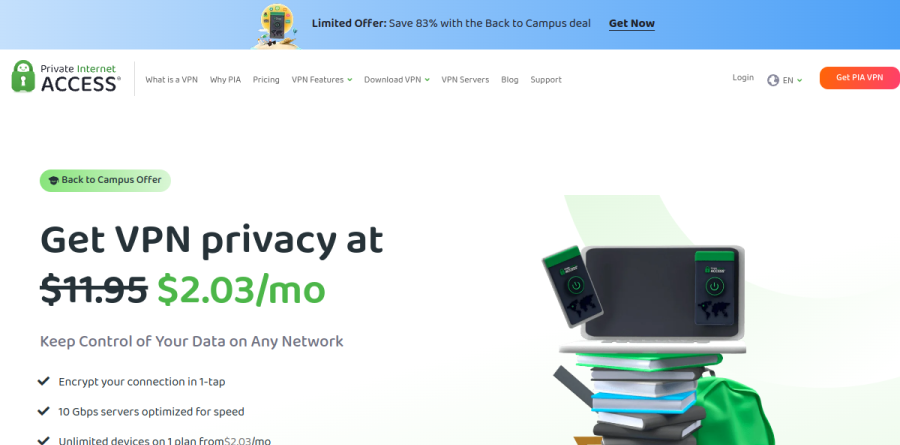
What is Private Internet Access?
Private Internet Access, usually shortened to PIA, is a consumer VPN that encrypts your connection and swaps your visible IP address for one from its NextGen server network. The stack is deliberately unglamorous: WireGuard and OpenVPN as transport protocols, AES encryption, and client apps the vendor describes as 100% open source and open to public inspection.
Coverage is broad rather than boutique. PIA ships native clients for Windows, macOS, Linux, Android, and iOS, extensions for Chrome and Firefox, and setup paths for smart TVs, Chromebooks, and routers. One subscription carries unlimited simultaneous connections, the detail that decides things for most households.
The no-logs record behind the marketing
Every VPN claims it keeps no logs, so the useful question is what backs the claim. Private Internet Access points to three things on its own pages: RAM-only VPN servers, which it cites when describing its multi-hop route, independent audits the vendor reports were conducted by Deloitte, and a no-logs policy it describes as proven in court.
Configuration depth for people who like knobs

Configuration depth is where PIA separates itself. Split tunneling works at app and domain level, so a banking app can sidestep the tunnel while everything else stays inside it. The Advanced Kill Switch halts transmission when the VPN drops, DNS leak protection lets you use PIA resolvers or your own, and obfuscation wraps traffic in SSL so VPN use resembles ordinary browsing to an ISP. Multi-hop chains an extra server onto the route, port forwarding is available on selected servers for torrent throughput, and you can choose between 128-bit and 256-bit AES encryption. PIA MACE blocks ads, trackers, and malware.
Plans, devices, and what the tiers gate
The lineup is short: a rolling 1 Month subscription, a 1 Year plan, and a multi-year 3 Years + 3 Months EXTRA option carrying the deepest discount, running under a Campus Sale banner when we checked. Features do not differ by tier, since unlimited device connections, a free Email Breach Monitor, and 24/7 support are listed with all three, so the only decision is term length. A 30-day money-back guarantee covers new subscribers, though app-store purchases follow the refund terms of those stores.
Dedicated IP and Antivirus add-ons

Two paid extras attach at checkout. The Dedicated IP add-on reserves an address only you use, cutting down on CAPTCHAs, repeated verification prompts, and blocklist damage inherited from strangers on a shared pool. PIA implements it with an anonymous token you generate on the site and paste into the app; the vendor states this keeps the address unlinked from your account, even internally. There are 23 dedicated IP locations listed, spread across North America, Europe, Asia, and Australia. PIA Antivirus, the second add-on, scans and removes malware from Windows PCs without tracking user activity or logging connection data.
Streaming, gaming, and everyday remote access
PIA supports P2P on every server with unlimited bandwidth, and the vendor credits 10 Gbps network cards across the NextGen fleet for holding up under streaming and low-latency gaming. Smart DNS switches virtual location straight from a smart TV, while router configuration extends protection to hardware that cannot run a client itself. Remote workers benefit from the Dedicated IP add-on, since corporate systems treat a shifting address as a risk signal. Support runs 24/7 in English, French, German, and Romanian.
Who should choose Private Internet Access
Private Internet Access suits people who want maximum control for minimal outlay. Large or shared households gain most from unlimited connections, torrenters get port forwarding and P2P support on every PIA server, and anyone who enjoys tuning ciphers and split-tunnel rules will find those controls exposed in the app. The audit history and open-source clients make PIA a sensible default for privacy-first buyers too. It is a weaker fit if you want one button and nothing else, or if you will not commit to a long term, because the headline rate lives on the longest plan and there is no free tier to fall back on.
Strengths
- Exceptional value — 3-year intro around $1.33/mo, far cheaper than NordVPN or ExpressVPN
- Unlimited simultaneous device connections on a single subscription
- No-logs policy proven under FBI court subpoenas and confirmed by 2022 and 2024 Deloitte audits
- 100% open-source apps with WireGuard, kill switch, split tunneling and the MACE ad/tracker blocker
Watch out for
- Speeds trail top-tier rivals (NordVPN, ExpressVPN, Surfshark) on longer-distance routes
- Advertised $1.33/mo is intro-only; the plan autorenews at $79 every 3 years (~$2.19/mo)
- US-based (Five Eyes jurisdiction), a concern for the most privacy-sensitive users
- Less consistent for streaming unblocking than NordVPN or ExpressVPN
Key features
| Feature | What it does |
|---|
| Court-proven no-logs | Stores no IP, traffic, timestamp or bandwidth data; multiple FBI subpoenas returned nothing, and Deloitte Romania verified zero logs in 2022 and 2024. |
| Unlimited devices | Connect an unlimited number of devices on one subscription — no cap, beating NordVPN (10) and ExpressVPN's limits. |
| Open-source apps | PIA is one of the few VPNs to publish 100% open-source client code across all platforms for public inspection. |
| WireGuard & OpenVPN | Modern WireGuard plus OpenVPN with AES-256 encryption, configurable kill switch, split tunneling and DNS-leak protection. |
| MACE blocker | Built-in feature that blocks ads, trackers and known malware domains at the DNS level. |
| Large server network | Servers across roughly 91 countries, including all 50 U.S. states, for broad geographic coverage. |
How Private Internet Access compares
| Alternative | How it differs |
|---|
| NordVPN | Faster via NordLynx and stronger for streaming, but pricier at ~$3.49/mo (2-yr Basic) and capped at 10 devices. |
| ExpressVPN | Top-tier speeds and reliable streaming, but among the priciest major VPNs with limited simultaneous connections. |
| Surfshark | Fellow budget VPN that also allows unlimited devices and often posts faster speeds, though with a shorter track record. |
Frequently asked questions
How much is Private Internet Access?
PIA's monthly plan is $11.95. The one-year plan drops to $3.33/mo ($39.95 billed annually). The headline 3-year plan advertises $1.33/mo with 3 bonus months (89% off), but it autorenews at $79 every three years (about $2.19/mo). All plans include a 30-day money-back guarantee for new subscribers.
Is Private Internet Access good?
Yes, for value and privacy. PIA offers unlimited simultaneous devices, 100% open-source apps, and a no-logs policy proven under FBI court subpoenas and confirmed by 2022 and 2024 Deloitte audits. Security.org measured over 90% download-speed retention. It trails NordVPN and ExpressVPN on raw speed and streaming, so it isn't the fastest option.
Is Private Internet Access safe?
PIA is safe and independently audited. It uses WireGuard and OpenVPN with AES-256 encryption, a kill switch and DNS-leak protection. Its no-logs claim is court-tested — FBI subpoenas returned no usable data — and Deloitte verified zero logs in 2024. The main caveat is US (Five Eyes) jurisdiction, though there is no data to hand over.
Private Internet Access vs NordVPN — which is better?
PIA is cheaper and allows unlimited devices; its 3-year intro runs about $1.33/mo versus NordVPN's roughly $3.49/mo two-year Basic plan, which caps at 10 devices. NordVPN is faster via NordLynx and better for streaming, with extras like Threat Protection. Choose PIA for value and device count; NordVPN for top speed and streaming reliability.
Does Private Internet Access keep logs?
No. PIA runs a strict no-logs policy, storing no IP addresses, traffic, timestamps or bandwidth data. The policy has held up under multiple FBI subpoenas where PIA produced no usable data, and independent Deloitte Romania audits in 2022 and 2024 confirmed zero logs. Apps are fully open-source, so the code can be independently inspected.
Private Internet Access ratings on other platforms
Independent user ratings from third-party review sites, linked here for transparency.
These are not our editorial score, are captured on the date shown, and may have changed since.