The full review
What is MarketMuse?
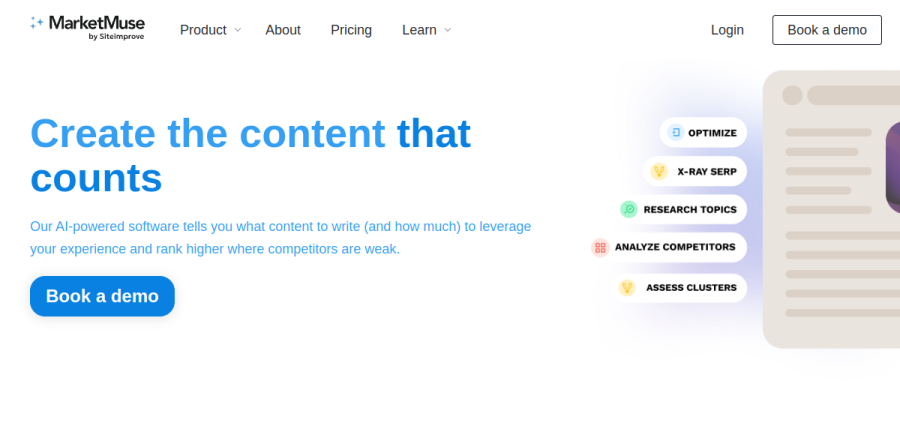
MarketMuse is a content strategy platform built on topic modeling rather than keyword lists. The homepage pitch is blunt: its AI tells you what content to write, and how much, so you can rank where competitors are weak. The product sits upstream of writing itself. You point MarketMuse at a site, it builds an Inventory of what already exists, then scores that library against the topics you want to own.
The vendor describes the workflow as Research, Plan, Brief, Write, and each stage has a named application: Competitive Content Analysis, Content Planning, the Content Brief Generator, and Optimize for pages you already published. MarketMuse says its typical customers are brands, publishers and agencies, used day to day by SEOs, content strategists, editors and writers.
Finding the gaps competitors leave open

Competitive Content Analysis is where most research sessions start. The Heatmap grids topic coverage across the top 20 SERP results or across a competitor cluster and sorts by what is missing, so a strategist sees instantly which subtopics everyone under-covers. SERP X-ray compares a single page against the SERP average and surfaces structural must-haves such as headings, images and links. Heatmap data exports, which matters when the analysis has to travel into a client deck. The vendor reports that its models read hundreds to thousands of pages per topic rather than only the top handful of results.
Metrics tuned to your domain
The most distinctive piece of MarketMuse is Personalized Difficulty. Instead of one universal keyword difficulty score, it estimates how hard a topic is for your specific domain, weighted by the Topic Authority you have already earned. Paired with the automated Inventory, which MarketMuse keeps current without manual crawls, a vague backlog becomes a ranked one. Teams use it to catch decaying pages and to defend priorities with evidence instead of instinct.
From strategy document to writer-ready brief

Content Strategy Documents turn research into assignments, covering what to create, what to update, the keyword clusters behind each group and a competitive overview. Those groups feed the Content Brief Generator, which delivers more than an outline: related topics, questions to answer, internal linking suggestions and structural guidance. Only the Strategy plan unlocks all nine brief types — Article, News/Event, Local, Comparison, FAQ Collection, How-to, Product Review, Listicle and Guide — while the Optimize and Research plans are limited to Article briefs, alongside the Optimize brief for pages already live. Briefs are tunable for point of view, expertise, style, tone and target market, which helps a freelancer sound like your brand rather than like the SERP.
Clusters and the links that connect them
Ranking for a topic rarely rests on one page, and Content Clusters is built on that idea. MarketMuse ranks clusters by opportunity against the authority you already hold, and the Site Heatmap exposes coverage up to 20 pages deep so thin areas stand out. Link Recommendations then wire the cluster together, which MarketMuse describes as unifying the reader's journey by linking content.
How MarketMuse packages access
MarketMuse offers four plans, named Free, Optimize, Research and Strategy, separated by capacity rather than by walling off core analysis. The pricing table lists Topic Navigator, Keywords, SERP X-ray and Site Heatmap access on every tier including Free, though MarketMuse's own Content Clusters FAQ says only the Strategy subscription has the site-level Heatmap. What scales is volume: seats, tracked topics, monthly queries, content briefs and strategy documents. Optimize fits a solo publisher shipping regularly, Research adds seats and unlimited queries for a small team, and Strategy targets larger teams and agencies with every brief type unlocked.
Who should choose MarketMuse
Choose MarketMuse when content is a genuine channel and the bottleneck is deciding what to write rather than writing it: agencies defending roadmaps to clients, publishers pruning large libraries, in-house teams briefing freelancers at volume. The personalized metrics pay off most on a site with enough history for the Inventory to learn from, and the demo-led purchase suits buyers who expect a conversation before committing.
It is a weaker fit for a brand-new site with a dozen pages, or for anyone who wants instant self-serve checkout. MarketMuse does report lost rankings and content decay inside its plans, and the applications it markets are Competitive Content Analysis, Content Clusters, Content Planning, the Content Brief Generator and Optimize.
Strengths
- Best-in-class topic modeling and content-depth scoring for planning at scale
- Content inventory and gap analysis give a genuine site-wide strategy view most rivals lack
- Detailed, structured content briefs speed up writer handoffs
- Personalized difficulty scores reflect your site's actual authority, not a generic metric
Watch out for
- Expensive versus Surfer, Frase, and Clearscope for comparable on-page optimization
- Pricing turned opaque after the 2024 Siteimprove acquisition — paid tiers gated behind demos/quotes
- Steep learning curve; the query-credit model and interface are more complex than peers
- Free tier (10 queries/mo) is too thin for real evaluation, and product direction under Siteimprove is uncertain
Key features
| Feature | What it does |
|---|
| Topic modeling & optimization | AI analyzes the SERP to build a topic model, scoring your content's depth and coverage against competitors and suggesting terms to add. |
| Content Inventory & gap analysis | Crawls your site to inventory pages, then surfaces content gaps, cluster opportunities, and pages worth updating. |
| Content Briefs | Auto-generates structured writer briefs with subheadings, related topics, questions to answer, and word-count and linking targets. |
| Personalized difficulty & competitive insights | Difficulty scores tuned to your domain's authority, plus competitive content analysis to prioritize where you can realistically win. |
How MarketMuse compares
| Alternative | How it differs |
|---|
| Surfer SEO | Cheaper, faster SERP-based on-page optimization; weaker at portfolio-level content strategy. |
| Clearscope | Simpler, premium content-grading tool; far less inventory and strategy depth. |
| Frase | Budget-friendly AI briefs and drafting; lighter topic modeling than MarketMuse. |
Frequently asked questions
Is MarketMuse still available after the Siteimprove acquisition?
Yes. It remains at marketmuse.com, but Siteimprove completed its acquisition of MarketMuse in November 2024 and is folding it into the broader Siteimprove platform. Since then, paid pricing has moved behind demos and quotes rather than being publicly listed.
Does MarketMuse write content for me?
Its focus is strategy, optimization, and briefs rather than long-form generation. It includes AI drafting features, but it's best used to guide human or AI writers — not to replace them.
MarketMuse ratings on other platforms
Independent user ratings from third-party review sites, linked here for transparency.
These are not our editorial score, are captured on the date shown, and may have changed since.