The full review

What is Kore.ai?
Kore.ai is an enterprise agentic AI platform for building and running AI agents that handle customer service, employee productivity, and back-office process automation. Instead of one chatbot product, Kore.ai packages a build-and-runtime foundation called Agent Platform { Artemis } underneath two enterprise modules, AI for Service and AI for Work, along with pre-built applications for banking, healthcare, retail, IT, HR, and recruiting.
The vendor positions the platform as the AI-programmable foundation for building, scaling, and optimizing AI agents that work in production. In practice Kore.ai spans the full lifecycle: authoring agents, orchestrating them across systems, testing behavior, deploying to channels, and auditing what happened.

The Artemis layer is where Kore.ai separates itself from lighter chatbot builders. Agent behavior is expressed in Agent Blueprint Language, a compiled, schema-driven language that captures tools, guardrails, orchestration, and handoff logic as formal structure rather than loose prompt text. Alongside it sits Arch, which the vendor describes as a built-in AI solution architect that turns natural language requirements into working agents, workflows, tools, and policies.
Teams build in Agent Studio, which pairs visual authoring with code in one workspace, and Kore.ai lists support for AI dev tools including Claude Code, Cursor, and Codex.
AI for Service is aimed squarely at the contact center. AI Agents carry multi-turn conversations that retain context, Agentic Contact Center matches customers to the right resource, and Agent AI Assistance surfaces live guidance to human agents mid-interaction. Quality Assurance scores interactions automatically instead of sampling a handful by hand, Outbound Campaigns drive proactive outreach, and Conversation Intelligence rolls sentiment, topics, and KPIs into reporting. The vendor reports customer results including a 25% reduction in average handle time and 75% automated interactions.
What AI for Work unlocks internally
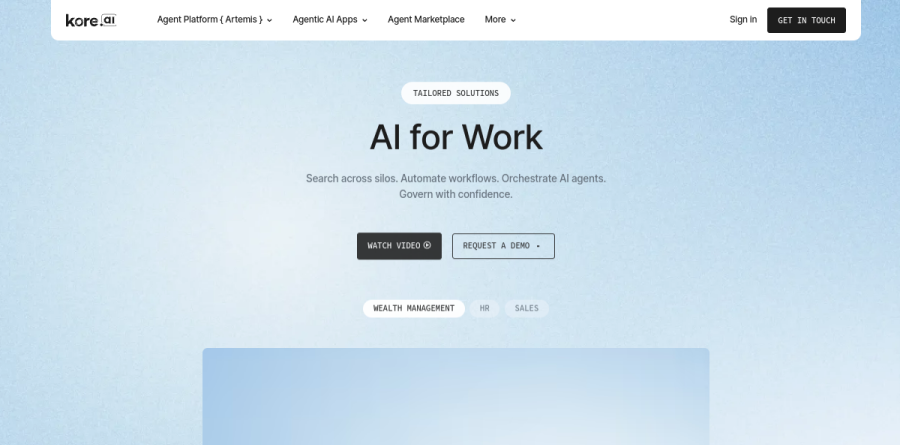
AI for Work covers the employee-facing half. Enterprise Search applies agentic RAG across structured and unstructured sources with role-based access controls, so an HR or finance question returns an answer instead of ten links. AI Agent Builder spans no-code through pro-code paths, and the site lists more than 200 pre-built templates and 9,000+ API actions reaching systems such as SAP and ServiceNow. Intelligent Orchestrator coordinates multi-agent workflows by routing tasks and transferring context between agents, while Admin Controls handle workspace management, analytics dashboards, and compliance posture.
Testing, governance, and deployment control
Kore.ai gives production readiness its own layer of the platform, spanning evaluation, observability, and lifecycle management. Agent Evals validate quality, safety, and accuracy across scenarios before release; observability traces reasoning, tool calls, guardrails, and handoffs; lifecycle management brings versioning, experiments, rollouts, and rollbacks. The platform is model-agnostic, listing Claude, OpenAI, Llama, Gemini, Cohere, and Mistral, and deploys on AWS, Azure, Google Cloud, private VPC, on-premise, or hybrid infrastructure. Channel connectors reach Slack, Microsoft Teams, Zoom, Genesys, and Webex, with integrations into Salesforce, ServiceNow, Zendesk, Epic, and SAP.
How Kore.ai plans are packaged
Kore.ai does not publish a rate card on its main platform page, which instead routes buyers to Request a Demo, Talk to an Expert, or Submit RFP. Product documentation names the tiers Essential, Advanced, and Enterprise, metering automation and Search AI per 15-minute session while Contact Center and Agent AI are billed per seat. Developer documentation also describes a Standard pay-as-you-go option with signup credits.
Who should choose Kore.ai
Kore.ai suits large, often regulated enterprises that need agents running in production with auditability attached: banks, health systems, telecoms, and retailers handling customer service and internal support at volume. Buyers who care about formal agent definitions, evaluation harnesses, and VPC or on-premise deployment will find far more depth here than in a typical conversational AI tool. It is not ideal for a small team hoping to have a support widget live by Friday, since the structure, procurement path, and sales-led pricing assume a real implementation project behind them.
Strengths
- Gartner-recognized enterprise leader with deep, mature omnichannel conversational AI covering both voice/IVR and chat
- Model-agnostic (LLM-agnostic) architecture lets you bring your own model and avoid vendor lock-in
- Broad single-platform suite: automation, agent assist, QA, proactive outreach, analytics, plus prebuilt industry agents
- Enterprise-grade security, compliance, and private-cloud/on-prem deployment options
Watch out for
- No transparent enterprise pricing: contact-sales only, with quotes reportedly starting around $300k/yr
- Per-15-minute-session billing makes costs unpredictable and penalizes long conversations
- Steep learning curve; realistically needs technical/developer resources to deploy and maintain well
- Overkill and poor value for SMBs or simple helpdesk use cases
Key features
| Feature | What it does |
|---|
| AI for Service | Agentic contact-center suite: autonomous AI agents, live-agent assist, quality assurance, and proactive outreach across chat and voice channels. |
| Agent Platform (Artemis) | Model-agnostic foundation to build, orchestrate, scale, and monitor production AI agents; bring your own LLM. |
| AI for Work | Workplace productivity layer with enterprise search (RAG across internal apps), prebuilt department agents, and admin controls. |
| Prebuilt agents & marketplace | Industry-specific templates for banking, healthcare, retail, IT, and HR, plus a marketplace of agents and integrations. |
How Kore.ai compares
| Alternative | How it differs |
|---|
| Cognigy | Closest enterprise rival: omnichannel voice + chat conversational AI for contact centers, often with clearer commercial engagement. |
| Ada | AI-first customer service automation that is faster to stand up and more transparent, though lighter on voice/IVR depth. |
| Intercom (Fin AI) | AI support agent tied to Intercom's helpdesk with published per-resolution pricing; simpler for mid-market chat support. |
Frequently asked questions
Does Kore.ai publish its pricing?
Not for enterprise. The official pricing page is contact-sales only. The one officially documented rate is the pay-as-you-go Automation AI charge of $0.20 per 15-minute session, with $500 in free workspace credit for new accounts (valid 90 days). Seat-based Contact Center and Agent products are quote-only.
Is there a free trial?
There is no traditional free plan, but new workspaces receive $500 in free credit that can be spent across assistants on the pay-as-you-go tier. It expires 90 days after the workspace is created.
Kore.ai ratings on other platforms
Independent user ratings from third-party review sites, linked here for transparency.
These are not our editorial score, are captured on the date shown, and may have changed since.