The full review
What is Decagon?
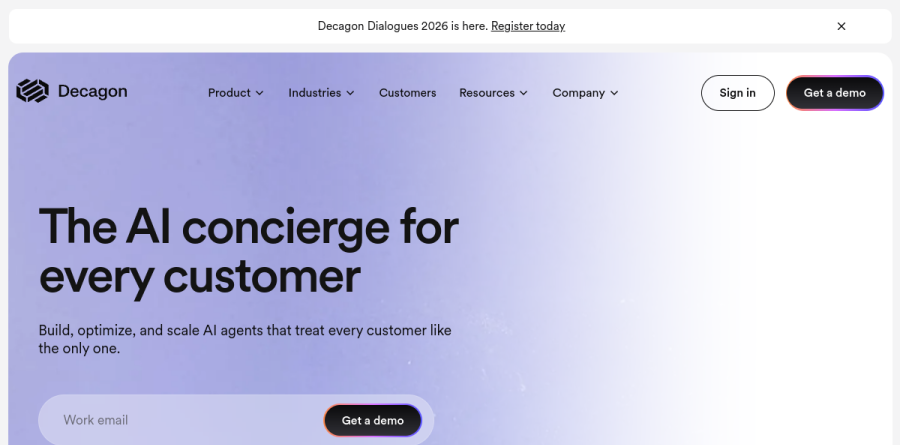
Built for enterprise support organizations, Decagon automates customer conversations across chat, email and voice. The homepage headline is "The AI concierge for every customer," under the subhead "Build, optimize, and scale AI agents that treat every customer like the only one," and the Voice page describes escalation as transferring calls to human agents "with a concise summary, ensuring a smoother handoff."
It sits on top of infrastructure a support org already owns, connecting to ticketing platforms, CRMs, knowledge bases, CCaaS providers and custom internal tools. The customer wall on decagon.ai names Deutsche Telekom, American Airlines, Duolingo, Chime, Ticketmaster, Square and Oura, with case studies fronting Away, Hertz, Noom and Faire — a fair signal of the scale Decagon is built for.
Agent Operating Procedures put CX teams in control

The centerpiece is Agent Operating Procedures, or AOPs, which the vendor says it pioneered. An AOP blends natural language with code so a support lead can describe agent behavior the same way they would write an SOP for a human hire. That matters organizationally more than technically: CX teams can build and revise agent logic without queuing behind engineering, while developers keep Git-based version tracking and ownership of the underlying code. Decagon says AOPs make workflows "fast to build, easy to inspect, and simple to adapt as your business changes."
One agent across voice, chat and email

Decagon treats omnichannel as a design principle rather than a bundle of separate bots. Memory carries customer context across sessions and channels, so a chat thread that becomes a phone call does not restart from zero. The Voice product handles turn-taking with interruptions and overlapping speech, offers hundreds of voice profiles including custom-tuned options, supports outbound calling, and covers 70+ languages with automatic detection and switching. Escalations pass a call summary to the human agent picking up.
Testing, guardrails and always-on QA
For teams nervous about turning an agent loose, Decagon leans hard on control surfaces. Testing and simulations "evaluate updates to your agent with simulated conversations and unit testing," while Versioning and experiments "A/B test workflow updates against real conversations with full impact measurement." Observability traces an agent decision step by step, and Watchtower provides round-the-clock monitoring of conversations. Guardrails cover brand voice, escalation rules and hallucination limits. Duet reviews transcripts, flags gaps and drafts workflow improvements; Duet Autopilot extends that into self-improvement, per the vendor.
Insights that feed back into the product
Insights and Reporting is more than a CSAT dashboard. Teams track deflection rates and AOP-level breakdowns, ask questions of their support data in plain language, and read customer journey diagrams to find friction. Voice of the Customer views group conversations into topics and themes, knowledge base reporting shows which articles get referenced and clicked, and heatmaps surface spikes or declines. Suggestions, listed separately under Scale, offers "AI-powered recommendations across your knowledge base, workflow design, and tooling."
What buying Decagon actually involves
There is no public pricing page on decagon.ai — no plan names, no calculator, no self-serve signup. Every path leads to a demo request, so expect a scoping call, a security review (Decagon maintains a dedicated Security page) and a negotiated contract. Budget owners should plan for procurement time and ask directly how usage is metered before committing.
Who should choose Decagon
The platform suits mid-market and enterprise support organizations carrying serious ticket volume across more than one channel, with CX operations staff who can own AOPs and act on the reporting. If your workflows are genuinely complex — refunds, account changes, regulated disclosures — the AOP model plus guardrails is a stronger fit than a generic knowledge-base bot. Decagon is not ideal for small teams or early-stage startups who want a published price and a card-on-file signup, because nothing here is self-serve.
Strengths
- Strong real-world deflection: customers report 70-95% automated resolution
- Genuine omnichannel — voice, chat and email from one intelligence layer
- Agent Operating Procedures let ops teams define workflows in plain language, not code
- Enterprise-grade tooling: A/B testing, QA simulations, Watchtower monitoring and analytics
Watch out for
- Zero pricing transparency — every quote is sales-gated and custom
- High cost of entry: ~$50k platform fee before any usage, six-figure typical contracts
- Priced and built for large enterprises; unworkable for SMBs and startups
- Usage billing (per-conversation) can charge even when the AI fails to resolve
Key features
| Feature | What it does |
|---|
| Agent Operating Procedures (AOPs) | Define support workflows and guardrails in natural language instead of building complex decision trees or flows. |
| Omnichannel deployment | Deploy the same AI agent across voice, chat and email from a single knowledge and intelligence layer. |
| Watchtower QA & testing | Continuous quality monitoring plus A/B testing and QA simulations to validate agent behavior before and after launch. |
| Insights & analytics | Conversation-level reporting and customer intelligence to track deflection, CSAT and improvement opportunities. |
How Decagon compares
| Alternative | How it differs |
|---|
| Intercom Fin | Transparent $0.99-per-resolution pricing and faster self-serve setup; less bespoke enterprise tuning. |
| Sierra | Similar enterprise AI-agent positioning and outcome-based pricing; also quote-only and premium. |
| Ada | Established enterprise support automation with broad channel coverage; comparable sales-led model. |
Frequently asked questions
Does Decagon publish its pricing?
No. There is no public pricing page — all pricing is custom and quote-based via their sales team. Third-party sources cite a ~$50k annual platform fee plus per-conversation (~$0.99) or per-resolution (~$0.50) usage, with typical contracts in the low-to-mid six figures.
Is Decagon suitable for small businesses?
Not really. With a ~$50k platform floor and six-figure median contracts, Decagon targets high-volume enterprises. Smaller teams are better served by self-serve tools like Intercom Fin.
Decagon ratings on other platforms
Independent user ratings from third-party review sites, linked here for transparency.
These are not our editorial score, are captured on the date shown, and may have changed since.